What Is Qwen 3.8 27B? What’s Confirmed, What Isn’t, and Why the Difference Matters
Qwen 3.8 27B is the open-weight member of Alibaba’s Qwen3.8 family, announced on August 3, 2026 alongside the Qwen3.8-Max flagship and positioned as the model you can actually run on your own hardware. As of this writing the weights have not been published, no licence has been named, and the spec sheet is almost entirely empty — which makes “what is it?” a more interesting question than usual, because the honest answer is mostly a list of things nobody outside Alibaba knows yet.
This is a what-we-know piece, not a review. Everything below is labelled confirmed, unknown, or inferred from the previous generation, because on an unreleased model that distinction is the entire value.
What is confirmed
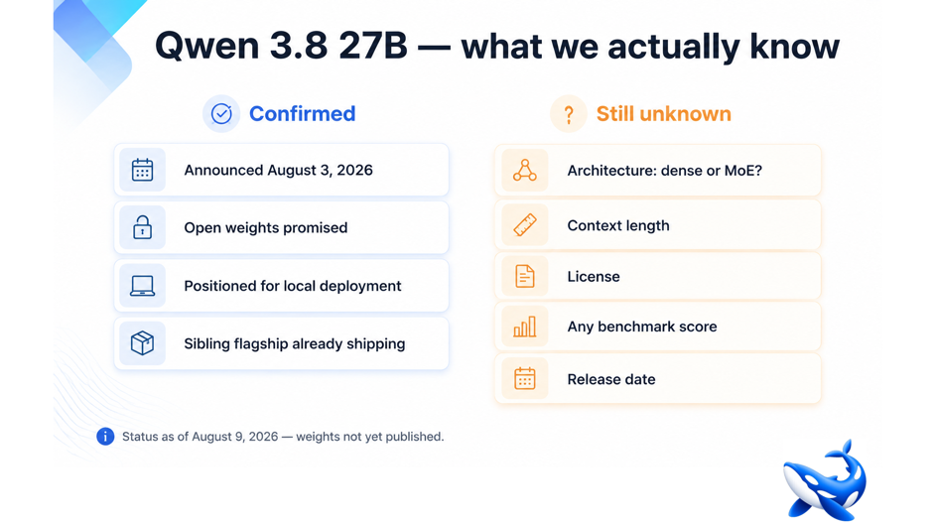
It exists and it was announced. Alibaba unveiled the Qwen3.8 family on August 3, 2026, with two members: the Qwen3.8-Max flagship and this 27-billion-parameter model.
The weights were promised as open. Alibaba committed to publishing them on both Hugging Face and ModelScope “within the week” of the announcement. Notably, this is the first time a Max-generation Qwen family has carried an open-weights promise at all — previous Max flagships stayed API-only with no self-hostable sibling.
Its job is local deployment. Alibaba positioned the 27B explicitly as the realistic path for on-premise and local use, against a flagship that is API-only. At 27 billion parameters it lands in the size class that fits on a single workstation card once quantised, which is precisely why people are waiting for it.
The promised week has passed. As of August 9, there is still no official `Qwen/Qwen3.8-27B` repository on the Hugging Face hub. The gap between announcement and payload is currently the whole story.
What is not known — and it’s most of it
• Architecture. Dense or mixture-of-experts has not been stated. This matters more than it sounds: it changes how the model behaves under batching even though, for MoE, VRAM stays roughly the same because all experts must be resident.
• Context length. Unpublished.
• Licence. Unpublished. Qwen 3.5 and 3.6 both shipped under Apache-2.0, which is a strong pattern — but a pattern is not a commitment, and for anyone whose deployment depends on the licence, this is the single most consequential blank on the sheet.
• Any benchmark score. There is not one published number for this model, from Alibaba or anyone else.
• Modalities, quantised builds, exact parameter count beyond “27B”, release date. All open.
The best available proxy: the model before it
Since the new spec sheet is blank, the most grounded thing anyone can say is what the previous generation actually looked like. These are Qwen3.6-27B’s confirmed numbers, released April 2026 — not Qwen3.8-27B’s:
• Dense, not MoE, with a hidden dimension of 5120 across 64 layers
• Context 262,144 tokens natively, extensible to 1,010,000
• Apache-2.0
• Multimodal — text, image and video in, text out, with a vision encoder
• A hybrid attention layout: `16 × (3 × (Gated DeltaNet → FFN) → 1 × (Gated Attention → FFN))`
• SWE-bench Verified 77.2, GPQA Diamond 87.8, MMLU-Pro 86.2, AIME 2026 94.1
Treat that as the shape of the thing rather than a forecast. Generations change architecture; Alibaba has already changed attention design between releases. But if you are sizing hardware or planning an integration, planning against the predecessor is far more defensible than planning against a rumour.
The sibling that did ship
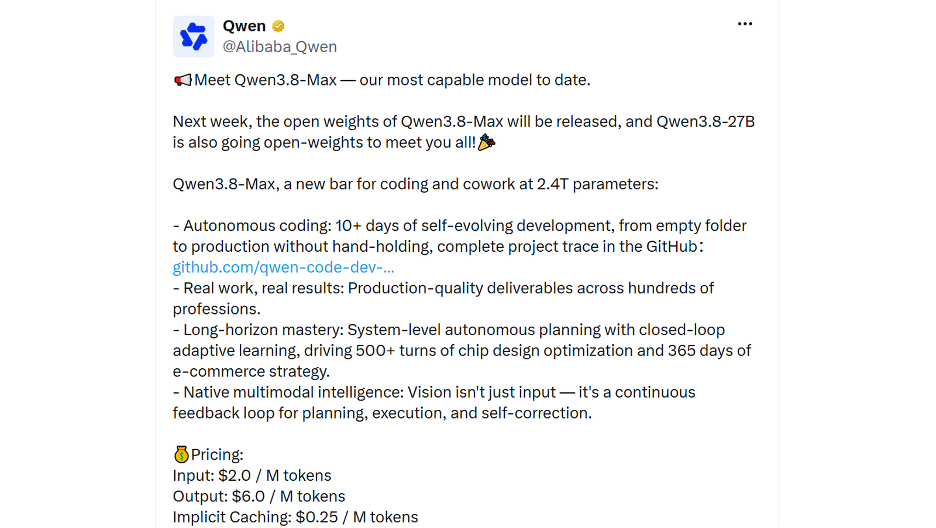
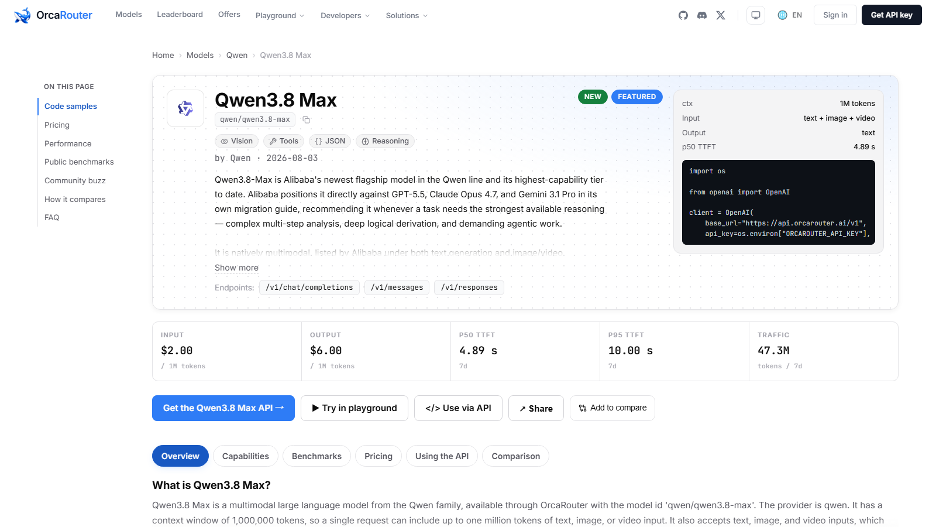
The contrast with the flagship makes the 27B’s status clearer. Qwen3.8-Max went live the same day the family was announced: a 2.4-trillion-parameter mixture-of-experts model with roughly 95 billion active parameters, a 1M-token context window, and text, image and video input, priced at $2 / $6 per million tokens on Alibaba’s own API — and available at that same list price through OrcaRouter’s catalog.
It also has something the 27B doesn’t: an independent score. Artificial Analysis places Qwen3.8-Max at an Intelligence Index of 56 at roughly $1.14 per task. That’s the only third-party measurement the generation has, and it belongs to the model you can’t self-host. You can call Qwen 3.8 Max today at $2 / $6 per million tokens, which makes it the baseline any eventual 27B will be judged against.
So the family currently splits cleanly: one member has a price, an API and an audited score; the other has a name and a parameter count.
A practical warning if you go looking for it
Search Hugging Face for the model today and you will find repositories named for it. Most are not what they appear to be.
We checked one — `huginnfork/Qwen3.8-27B-FP8` — on August 9. The owner is a third party, not Alibaba, and the model card says plainly: *”Status: placeholder. There are no weights in this repository yet”*, followed by *”Do not attempt to download or serve this repo — there is nothing here but this card.”* To the uploader’s credit it is honest about being empty. Not every placeholder will be.
Two checks before you download anything claiming to be this model:
• The owner must be `Qwen/`. Anything else is a mirror, a quantisation, or a placeholder — all of which can be legitimate, none of which is the source of truth.
• The repository must actually contain weight files. A model card alone is not a model.
What to do right now
Realistically, three options.
Wait, and prepare. Size your hardware against the predecessor’s shape, get vLLM or SGLang deployed and tested with any 27B-class model, and be ready to swap a model name on day one.
Run something that exists. Several genuinely open models in this class are downloadable today — Gemma 4 12B under Apache-2.0, Ling 3.0 Flash under MIT, Motif-3 under MIT — and they will tell you more about whether local inference suits your workload than any amount of waiting will.
Use the flagship through an API in the meantime. If what you actually need is Qwen3.8-generation quality rather than local weights specifically, Qwen3.8-Max is callable now. Behind an OpenAI-compatible endpoint that carries it at list price with no markup, swapping it for the 27B later is a config change rather than a project.
The takeaway
Qwen 3.8 27B is, today, a confirmed announcement and an unfulfilled promise: real, officially committed to open weights, positioned for local deployment — and lacking an architecture, a context length, a licence, a benchmark and a download. The most useful preparation is to plan against the previous generation’s real specifications rather than against speculation, to verify any repository claiming to be it, and to keep something you can actually run in place until the drop happens. When it does, the interesting question won’t be what it is — it’ll be whether the licence matches the pattern.