
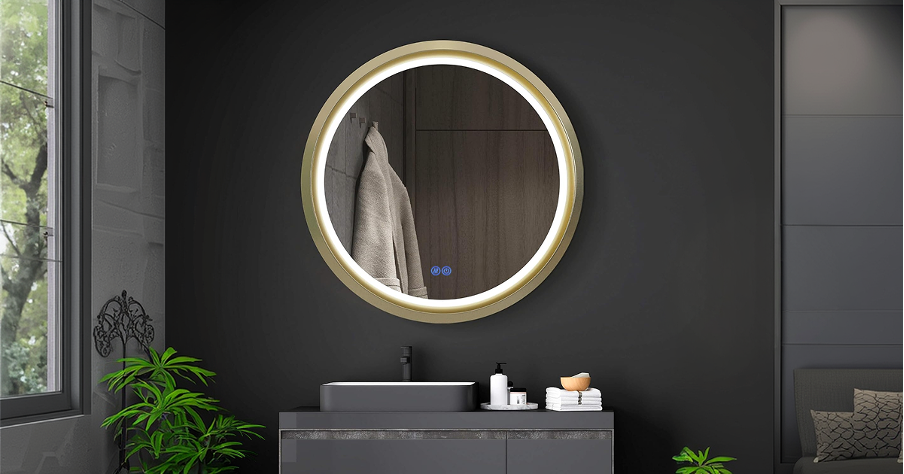
How to Choose the Right Round LED Mirror for Bathroom Wall
Bathroom mirrors have evolved from simple reflective surfaces into functional lighting fixtures that can influence how a space looks and performs. An LED bathroom mirror can provide task lighting for shaving, makeup application, skincare, and other daily routines while also contributing to the overall atmosphere of the room. A Round LED Mirror for Bathroom Wall is especially useful when a bathroom contains many straight lines from tile, cabinetry, countertops, and shower enclosures. The circular shape introduces visual contrast, while integrated lighting eliminates the need to rely entirely on overhead fixtures. Current U.S. bathroom mirror offerings commonly combine features such as dimming, multiple color temperatures, anti-fog systems, front lighting, and backlighting.
Choosing the right mirror, however, involves more than picking a shape that looks attractive. Size, mounting location, electrical requirements, lighting quality, safety certifications, and the dimensions of the vanity all matter.
Why Round Bathroom Mirrors Work Well in Modern Spaces
Rectangular mirrors naturally echo the horizontal and vertical lines already present in most bathrooms. A circular mirror breaks up those repetitive angles and can make a vanity wall feel less rigid.
The effect is particularly noticeable in contemporary, transitional, minimalist, and spa-inspired bathrooms. A round mirror can also work well above a single-sink vanity because its proportions create a clear focal point without visually dominating the entire wall.
Current bathroom design discussions also show increased interest in curved mirror shapes, including round, oval, arched, and other softened silhouettes. The broader trend reflects a move away from exclusively rectangular bathroom fixtures toward shapes that provide more visual variety.
The important distinction is that style should follow the room’s proportions. A round mirror that is too small can look disconnected from a wide vanity, while an oversized mirror can compete with wall sconces, cabinets, or other fixtures.
How to Choose the Right Mirror Size
Size is one of the most important decisions because the mirror needs to relate proportionally to the vanity and available wall space. For a single-sink vanity, the mirror is often narrower than the vanity itself. This creates visual margins on both sides and leaves room for wall-mounted lighting if it is used. A larger mirror can also work, but the surrounding fixtures need to be considered before installation.
For double vanities, homeowners typically have more options. One large horizontal mirror can create a continuous appearance, while two individual mirrors can give each sink its own defined zone.
Before purchasing, measure the finished vanity width, backsplash height, wall width, faucet position, cabinet doors, and nearby electrical components. Do not measure only the vanity and assume everything else will fit.
The mounting height matters as well. The mirror should provide comfortable viewing for the primary users without interfering with faucets, sconces, medicine cabinets, or other bathroom features.
Front-Lit vs. Backlit Bathroom Mirrors
Not all integrated LED lighting performs the same job. A front-lit mirror directs illumination toward the person standing in front of it. This can be useful for grooming tasks because the light is positioned to illuminate the face more directly.
A backlit bathroom mirror places LEDs behind the glass. Instead of directing most of the light toward the user, it creates a halo-like glow against the wall. Backlighting is often chosen for ambient illumination and visual effect.
Some contemporary models combine front and rear illumination. This arrangement can provide both functional task lighting and softer ambient light. U.S. retailers currently offer mirrors using this dual-lighting approach, along with dimming and adjustable color-temperature controls.
For a bathroom where grooming performance is the priority, front lighting deserves careful attention. If atmosphere and minimalist aesthetics matter more, backlighting may be sufficient. Combination lighting offers greater flexibility, but it can also increase complexity and cost.
Why Color Temperature Matters
Color temperature is measured in Kelvin (K) and describes the appearance of white light. Warm light generally appears more yellow or amber, while cooler light appears whiter or slightly bluish. Many modern lighted bathroom vanity mirrors allow users to switch between several color-temperature settings. For example, products currently available in the U.S. commonly advertise settings around 3000K, 4000–4500K, and 6000K.
There is no single temperature that is universally best. Warm lighting can create a relaxed atmosphere, while neutral white light may be more practical for everyday grooming. Cooler light can provide a brighter, crisper appearance but may feel harsher in some bathrooms.
If the bathroom serves several purposes, adjustable color temperature can be more useful than choosing one fixed setting.
Is an Anti-Fog Bathroom Mirror Worth It?
Fogging happens when warm, moisture-laden air contacts a cooler mirror surface. This is particularly common after showers. An anti-fog bathroom mirror uses a heating element or defogging system to keep part of the reflective surface clearer. Current LED mirror models frequently combine lighting with built-in defogging features, and some include automatic shutoff functions.
This feature can be useful in bathrooms that experience frequent steam. However, it should not be confused with making the entire bathroom moisture-proof. The mirror still needs to be installed according to the manufacturer’s requirements, particularly around electrical connections and wet locations.
It is also worth checking how much of the mirror surface is actually covered by the defogging area. Some systems concentrate heating around the central viewing zone rather than covering the complete glass panel.
Dimming and Lighting Controls
Brightness is another practical consideration. A bathroom does not always need maximum illumination. Bright lighting may be useful for shaving or detailed grooming, while lower brightness can be more comfortable during nighttime bathroom visits. Dimmable LED mirrors allow users to adjust illumination according to the situation.
Touch controls are common, but the exact control method varies. Some mirrors use touch-sensitive buttons, while others may connect to wall switches or other controls.
Memory functions can also retain a user’s preferred brightness or color-temperature setting. Several current U.S. models advertise memory controls alongside dimming and multiple lighting modes.
These features are conveniences rather than necessities. A mirror with fewer controls may actually be the better choice if simplicity is more important than customization.
Consider CRI for Grooming and Makeup
Color Rendering Index, or CRI, measures how accurately a light source reveals colors compared with a reference light source. This matters when applying makeup, choosing clothing colors, shaving, or performing skincare routines. A high-CRI light source can make colors appear more naturally than a lower-quality light source.
Some bathroom mirror manufacturers advertise CRI ratings of 90 or higher. A high CRI does not automatically mean the mirror is superior in every respect, but it is a useful specification when accurate color appearance is important. Look for the actual CRI specification rather than relying on descriptions such as “natural lighting” or “daylight effect.”
Glass, Safety, and Electrical Considerations
Bathroom mirrors with integrated electrical components require more consideration than ordinary decorative mirrors. Tempered glass is commonly used in some illuminated bathroom mirrors because it is designed to break into smaller, less dangerous pieces when fractured rather than producing large sharp shards. Current U.S. products include models manufactured with tempered glass.
Electrical safety is equally important. Look for appropriate certification and installation instructions rather than assuming that any lighted mirror is suitable for any bathroom location. Some products specify certifications such as ETL or UL and provide different installation methods, including plug-in and hardwired configurations.
Hardwiring should generally be handled by a qualified electrician when required. The manufacturer’s installation instructions and applicable local electrical requirements should take precedence over generic online advice.
A bathroom’s moisture exposure also makes enclosure and ingress-protection information relevant. Some models specify ratings such as IP54, but the rating should be interpreted according to the manufacturer’s documentation and the intended installation location.
How to Match the Mirror with Your Bathroom Style
The circular shape is versatile, but the surrounding finishes determine the final appearance. A frameless design tends to complement minimalist and contemporary bathrooms. A thin metal frame can introduce contrast and work well with black, brass, bronze, or brushed-metal hardware.
For a warmer transitional bathroom, a framed mirror can soften the appearance of white tile and cabinetry. In a small powder room, the mirror can become a deliberate focal point rather than simply serving as a functional fixture.
The lighting effect also changes the visual character. Backlighting creates a subtle glow around the perimeter, while front lighting is more noticeable and functional. Combining both can create a layered lighting effect.
Common Mistakes to Avoid
One common mistake is choosing a mirror based only on appearance. A beautiful mirror that is poorly sized for the vanity can make the entire installation look unbalanced.
Another mistake is assuming that more features automatically mean better performance. Anti-fog heating, multiple lighting modes, dimming, memory controls, touch sensors, and dual lighting can be useful, but each adds another component that can eventually require maintenance.
Ignoring installation requirements is another serious error. Before purchasing, confirm whether the mirror is designed for plug-in or hardwired installation, where its electrical components can be located, and whether additional electrical work is required.
Finally, do not overlook the existing bathroom lighting. An illuminated mirror should complement the room’s lighting plan rather than being expected to perform every lighting function by itself.
When a Round LED Mirror Makes Sense
A circular illuminated mirror is a practical choice when you want to combine a softer visual shape with integrated task or ambient lighting. It is particularly appropriate for single-sink vanities, contemporary bathrooms, powder rooms, and spaces where a conventional rectangular mirror would feel too rigid.
The best choice depends on how the bathroom is actually used. Start with dimensions and installation requirements, then evaluate lighting direction, brightness, color temperature, CRI, anti-fog functionality, glass construction, and electrical safety.
The goal is not to choose the mirror with the longest feature list. It is to choose one whose size, lighting, construction, and controls make sense for the room and the people using it every day.
As bathroom design continues to favor softer shapes and integrated functionality, the Round LED Mirror for Bathroom remains a useful example of how a single fixture can combine visual design with practical illumination.