
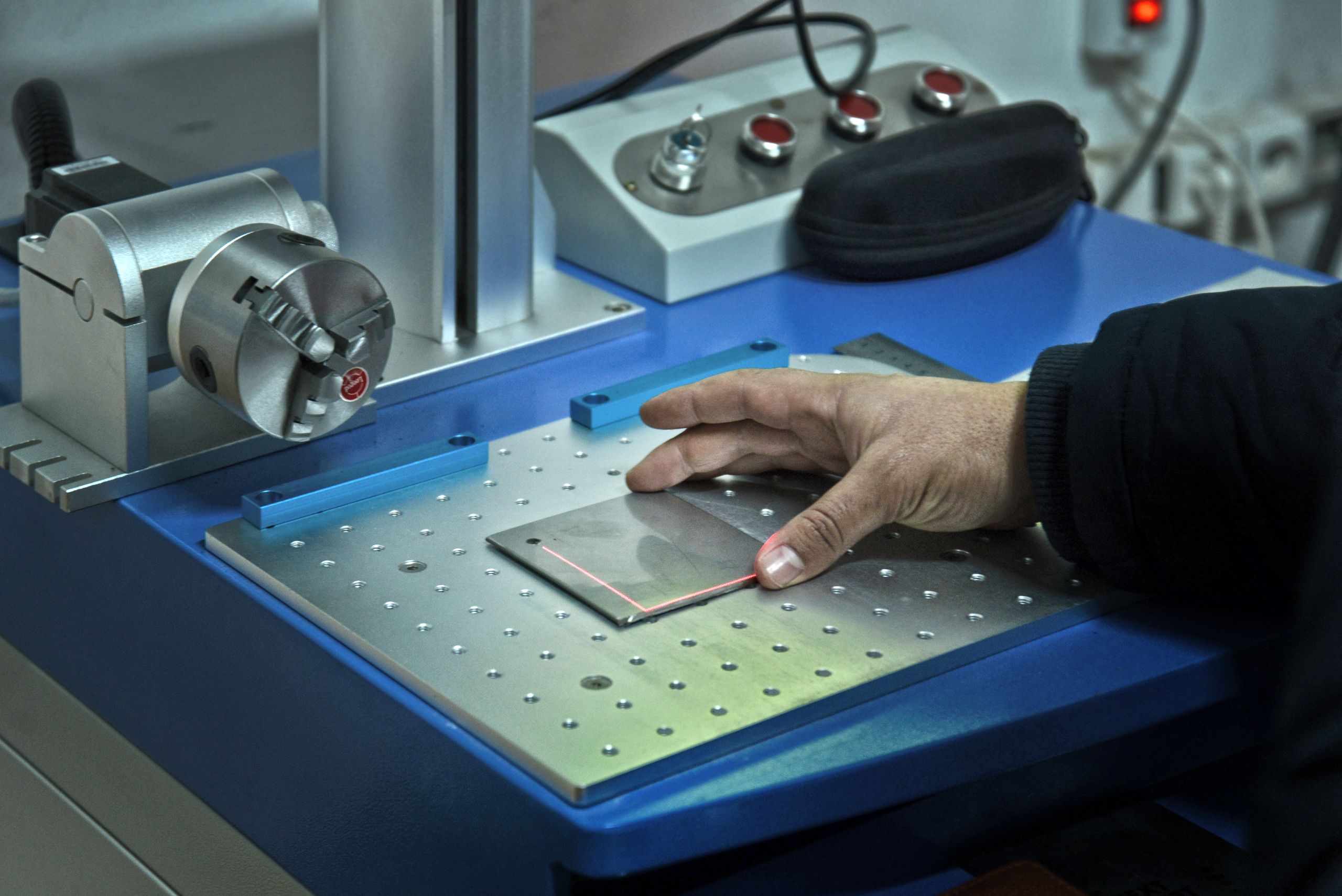
The Role of Laser Marking in Creating Permanent Product Labels
Product labeling plays an important role in modern manufacturing. Labels assist in product identification, convey important information, aid quality control, and guarantee traceability within the supply chain. Electronic components, automotive parts, medical devices and industrial equipment manufacturers require labeling that will not fade away, and that will be decipherable in the long term.
Conventional methods of labeling like stickers, ink printing, and engraved plates may be troublesome when the product is subjected to heat, moisture, friction, chemicals, or handling. Laser marking is a good alternative since it provides permanent markings on product surfaces.
With the current dynamism in manufacturing standards, laser marking has gained significance in those businesses that need to identify their products with accuracy, durability, and consistency.
What Is Laser Marking?
Laser marking is a non-contact type of manufacturing where a focused beam of laser is used to form text, figures, symbols, barcodes, QR codes, and logos among other identification details on the various materials.
The laser does not require the use of ink or a separate label, but it alters the surface of the material. This can be done by changing its color, drawing a contrast or a shallow engraved mark depending on the material and settings of the laser.
It can be applied on metals, plastics, ceramics and other appropriate materials. Various laser technologies are chosen based on the surface, marking needs and the environment of production.
Since the laser acts upon the product, no extra labels, adhesives or printing consumables are required. This renders the technology especially helpful to manufacturers who are interested in long-term identification solutions.
Why Permanent Product Labels Matter
Product labels are not just a simple identification. They assist manufacturers to have a well-organized production process and provide customers and service teams with valuable product information.
Permanent marking is especially useful in industries where product specifications have to be readable during the working life of the product.
The following are some of the key advantages:
1. Long-Lasting Identification
Traditional labels may be removed or erased with time or get spoiled. This may render it hard to locate products when they are being transported, stored, maintained or repaired.
Laser marking is used to inscribe identification on the surface of the product. Well made marks can withstand the harsh working environment, such as being exposed to abrasion, water and some chemicals.
This strength assists companies to retain product recognition even when the product is applied in a difficult environment.
2. Better Product Traceability
Producers usually require monitoring the products between manufacturing and delivery. This is established using serial numbers, batch codes, manufacturing dates, and QR codes.
Laser marking is what allows putting these details on individual products or components. Even minor components may have distinctive identification codes to aid inventory control, quality checks and after sales services.
In the case of industries that are very strict on traceability, permanent marking would allow an easier time in record keeping and product verification.
3. Enhanced Precision and regularity.
When the production volume is large, manual labeling can give inconsistent results. The appearance can be influenced by differences in label placement, printing quality, and human error.
Automated manufacturing processes can be used to incorporate laser marking systems. After the parameters of marking are set, it is possible to reproduce the same design in many products with the same equipment.
This uniformity assists the manufacturers to identify their products professionally and also minimizes the labeling mistakes.
Applications of Laser Marking Across Industries
Laser marking is a process that is useful in a great variety of manufacturing since it can be customized to various materials and product designs.
– Automotive Manufacturing
The automotive parts need credible recognition during their service life. Serial numbers, information about the manufacturer, and traceability codes may be required on engine parts, transmission parts, chassis parts, and other parts of the vehicle.
Laser marking offers long-term identification, which cannot be erased by vibration, heat, and frequent mechanical contacts.
– Electronics and Electrical Equipment
Small components are usually found in electronic products and the space available to identify them is usually limited. Laser marking is a technique used by manufacturers to print model numbers, logos, serial numbers and QR codes on circuit boards, connectors and device housings.
It is also accurate and can therefore be used in detailed markings where accuracy and readability are critical.
– Medical Device Manufacturing
Medical instruments and equipment might need to be marked permanently so as to aid in tracking, maintenance and regulatory needs. Product codes, serial numbers and other vital information can be copied to appropriate metal and plastic surfaces by laser marking.
The type of marking should be chosen wisely to maintain the integrity of material and comply with the requirements of the respective industry.
– Industrial Machines and equipment.
Industrial machinery is often subject to harsh treatment, oils, dust, and so on. Printed labels are not necessarily going to be stable in such conditions.
Laser-marked product information can assist in locating tools, machine components and equipment during its operational life.
How Laser Marking Creates Permanent Labels
There are a few key steps in the laser marking process which dictate how good and durable the final outcome will be.
The manufacturer will first choose the right laser technology depending on the material of the product and the required effect of the marking. Fiber lasers are usually applied to metals, and CO2 and UV lasers can be applicable to a variety of non-metallic materials and applications.
Then, the information needed is made in digital format. This can consist of text, logos, serial numbers, barcodes or other product information.
A regulated beam is then focused on the desired surface by the laser system. The appearance and depth of the marking can be controlled by operators through adjustment of such parameters as power, speed, frequency, and pulse duration.
Test markings are used prior to full scale production to ensure that the information is clear, in the right place and apt to the material. After the settings have been completed, they can then be propagated through production batches.
Key Advantages of Laser Marking Over Traditional Labeling
Laser marking has several practical benefits over the traditional product labeling techniques.
– Permanent marks: Markings are printed or sprayed onto the product instead of being used as separate labels or stickers.
– Minimal consumables: It does not involve traditional printing ink, ribbons or sticker labels.
– Fine text, complex logos, and machine-readable codes: It is possible to create fine text and elaborate logos on appropriate surfaces.
– Compatibility with automation: Laser marking devices are compatible with production lines and automation.
– Reduced wastage of materials: Direct marking will minimize disposable label materials.
– Adaptable designs: With digital control systems, manufacturers have the right to revise the product information and marking layouts.
These advantages can assist the companies in enhancing the efficiency of production as well as sustaining the same level of identification.
Selecting the Correct Laser Marking Solution
The choice of the equipment that is appropriate depends on the products that are to be marked and the environment that will be utilized. One of the crucial considerations is the type of material since various surfaces react differently to laser energy.
The manufacturers ought also to consider the speed of marking, the amount of detail required, production volume, space available and the automation requirements. As an example, a company that labels miniature electronic parts may emphasize accuracy whereas an automotive manufacturer may emphasize longevity and compatibility with existing production systems.
Software compatibility, operator safety, maintenance requirements, and technical support are also important to be considered. Experimenting the equipment with the real samples of the products will assist in deciding whether the chosen system provides the needed contrast, readability, and consistency.
Hispeedlaser provides an option to companies that are researching the field of industrial marking equipment to consider when assessing technologies in identifying products permanently. In order to know what system to use in their production, manufacturers can know the available equipment and application requirements to guide them in choosing the right system to be used.
The Future of Permanent Product Identification
The process of manufacturing is becoming more automated and the requirement of having trustworthy information about products is on the rise. Digital tracking, smart inventory systems, and related connected production spaces all require proper product identification.
Laser marking assists these developments by enabling manufacturers to mark machine-readable information on components. QR codes and data matrix codes, such as, may be used to bridge the gap between physical goods and digital data, which includes production history, inspection history, and history of maintenance.
Laser marking will probably continue to play a significant role in the effective identification and traceability of products as industrial processes continue to become more sophisticated.
Conclusion
Permanent product labeling is a necessary feature of identification, quality control, and traceability of contemporary industries. Laser marking is a viable solution because it designs precise and enduring information onto surfaces of products.
It is useful in automotive, electronic, medical and industrial applications because of its capability to create the same mark on the appropriate materials. Manufacturers can enhance the reliability of labeling and simplify their work by choosing equipment that compliments their materials, production needs, and marking targets.
Companies that seek to know more about the equipment and applications offered can learn more about Laser Marking solution by Hispeedlaser and how this technology can assist their product identification requirements..