
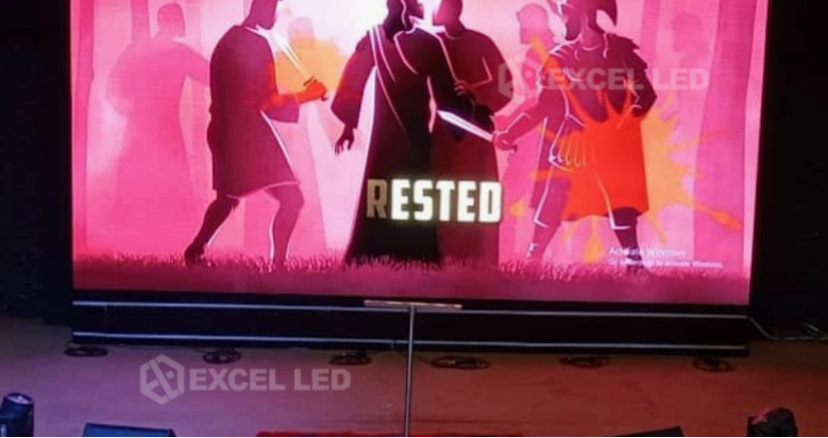
LED Projector vs. Church LED Screen: Which Is a Better Choice?
Visual displays have a big part to play in today’s church services. They help congregations follow song lyrics, read scripture passages, understand sermons, and interact with stage presentations. However, it is essential to determine the kind of projector or LED display that you want. They both give fantastic information, but they differ in terms of brightness, installation, maintenance, and price. Knowing these differences allows churches to select the right display to suit their worship space, congregation, and technical requirements without spending too much.
1. LED Projectors: Traditional Visual Display Solutions
Projectors always come in handy in churches where presentations and videos need to be displayed, and worship lyrics need to be projected. They can be used in existing AV setups and show images on a separate screen or on a suitable wall. They have a relatively low initial cost, which is attractive to smaller congregations and organizations that do not have a lot of equipment to spend.
However, image projection depends on ambient light and the distance between the projector and the screen. Increased lighting in the sanctuary can help to reduce contrast, making it harder to read the scripture passage and song words. In large venues, they may require powerful projectors, proper projection locations, and projection surfaces.
Projectors can be effective in a space where the lighting can be controlled, and distances are manageable. But over time, the lamps may need more maintenance due to aging, filter cleaning, lamp alignment, and replacement parts.
2. Church LED Screens: Modern Visual Display Technology
LED displays are displays that have single light-emitting diodes (LEDs) which directly emit bright images to the surface of the displays. Unlike projectors, they are not dependent on reflected light, so visuals will be visible in brighter worship settings. When churches employ a blend of stage lighting, daylight, and live video presentations, this distinction becomes important.
Using a Church LED Screen allows displaying lyrics, scripture, sermon slides, announcements, and camera footage all on one screen while ensuring good brightness levels throughout a large viewing area. The modular panels also allow churches to choose the size of the screens and design stage backgrounds based on their architectural design.
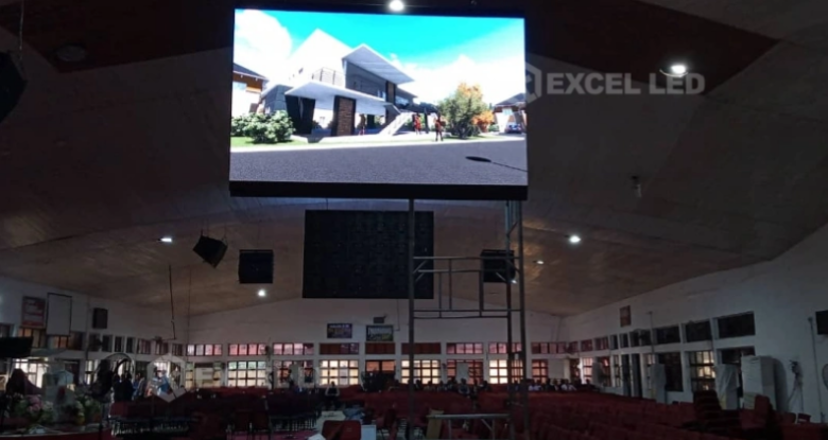
LED technology typically lasts long and doesn’t require a lamp change for the projector. However, the initial investment, installation requirements, and maintenance expenses are also factors to consider. Another benefit of fine pitch displays is that the text will be more legible – if congregants are seated reasonably close to the screen.
3. Comparing Image Quality and Congregation Visibility
What images are used in worship have a direct link to the ability of others to follow the worship presentation. Projectors will vary depending on the surface quality of the screen, distance from the projector, and the lighting of the room, but can produce clear projections under the correct lighting. Shadows can also be cast by people walking across the light path of the projector.
In illuminated sanctuaries, LED displays create their own light, which helps to maintain the contrast. Their brightness contributes to the easy readability of text, greater intensity of the background colors, and better quality of the video playing. Off-center viewers can also see the content more uniformly at wide viewing angles.
Church LED Screen technology can give a practical edge where visibility is key in a large church gathering, for a church that is considering a permanent installation. Even though it is no longer as important, pixel pitch is still important, as a small spacing will make the picture look much finer when viewed from a short distance. When choosing a display, churches should consider viewing distance, size of the screen, and camera needs.
4. Installation and Space Requirements
Projectors typically need to be mounted, have a minimum throw distance, be plugged in, and have a projection surface. Ceiling height, lighting, ventilation, structure, and potential obstructions should be considered when setting a ceiling. For larger sanctuaries, more than one projector might be required to ensure that the entire seating area can be seen uniformly.
The modular cabinets for LED displays can be wall-mounted, suspended, or supported by floor-standing structures. Fixed installations are used for permanent sanctuaries; ground-supported systems are used for more flexible temporary events. Recessed installations need to be measured and maintained from the front side, because it is impossible to get to the back side.
Electrical capacity, ventilation, cable routing, structural loading, and service access are among the other considerations. With care, there will be no need for costly changes once installation has started.
5. Maintenance, Lifespan, and Operating Costs
Purchase price alone does not determine which display offers better long-term value. Projectors generally cost less initially, but lamp replacements, filter cleaning, periodic adjustments, and eventual equipment upgrades can increase ownership expenses. Their brightness may also decline as components age.
LED displays typically avoid lamp replacement and require less routine maintenance, although individual modules, power supplies, and control components may eventually need servicing. Dust management, suitable ventilation, and correct operating conditions remain important for reliable performance.
Important Cost Considerations
- Initial investment: Projectors usually require less upfront spending.
- Replacement parts: Projectors may need recurring lamp or filter replacements.
- Service accessibility: Front-service LED cabinets simplify maintenance in recessed installations.
- Energy consumption: Actual usage depends on brightness settings, equipment specifications, and operating hours.
- Installation costs: Structural work, rigging, electrical upgrades, and cabling affect the total budget.
Manufacturers such as EXCEL LED offer configurable display solutions for different installation environments. Comparing warranties, replacement-part availability, technical assistance, and expected operating hours helps churches evaluate overall ownership costs.
6. Live Streaming and Recording Performance
In recent years, an increasing number of churches have been using cameras to provide a live stream of worship services and sermons online. The display technology may influence the appearance of the stage background, lyrics, and presentation graphics in recorded footage.
In the scenario where the ambient light reduces the contrast of the images, projectors may look washed out. The projected surfaces may also exhibit uneven lighting, depending on the equipment setup and the quality of the screen. These restrictions are likely to be more noticeable in brighter or more complex scenes.
LED displays can provide higher illumination and contrast for streaming setups. However, refresh rate, shutter, brightness calibration, and exposure also influence the performance of the camera. Prior to purchasing cameras, church displays need to be tested with the actual cameras. In many recording situations, a high refresh rate (3,840 Hz or higher) will reduce the amount of flicker and scanning artifacts that will be visible.
7. Choosing the Right Display for Your Church
The selection will be based on the size of the sanctuary, funding, lighting, and use. Projectors may be enough for smaller churches that have controllable lighting and have occasional presentations. Older projection equipment can even be valuable when it is not cost-effective to replace it.
Churches that have larger congregations, brightly lit sanctuaries, and churches that put a priority on stage visuals may be better served by LED displays. Smaller pitch sizes are suitable for closer viewing distances, and larger pitch sizes can be used in larger auditoriums. Dual side displays can be beneficial if the main stage is set back from the rear seats.
EXCEL LED is an indoor, rental, and outdoor display solution, allowing churches to weigh the options of permanent versus temporary event displays. Before purchasing equipment, evaluating screen size, pixel spacing, structure, and technical support required will help ensure that the equipment purchased will be able to handle the actual needs.
8. Conclusion
Projectors and LED displays each have their advantages when it comes to church communication. Projectors are also less expensive up-front and are effective in controlled lighting situations. The advantages of LED displays are that they are brighter, can be scaled to any size, and are more useful for large sanctuaries and for live streaming.
The choice of which is best will be based on the visibility requirements, installation location, maintenance, and cost. Churches need to consider all of the ownership costs, not just the purchase price. These factors can be carefully evaluated to ensure that congregations select a display system that will help to facilitate effective communication and worship experiences for years to come.