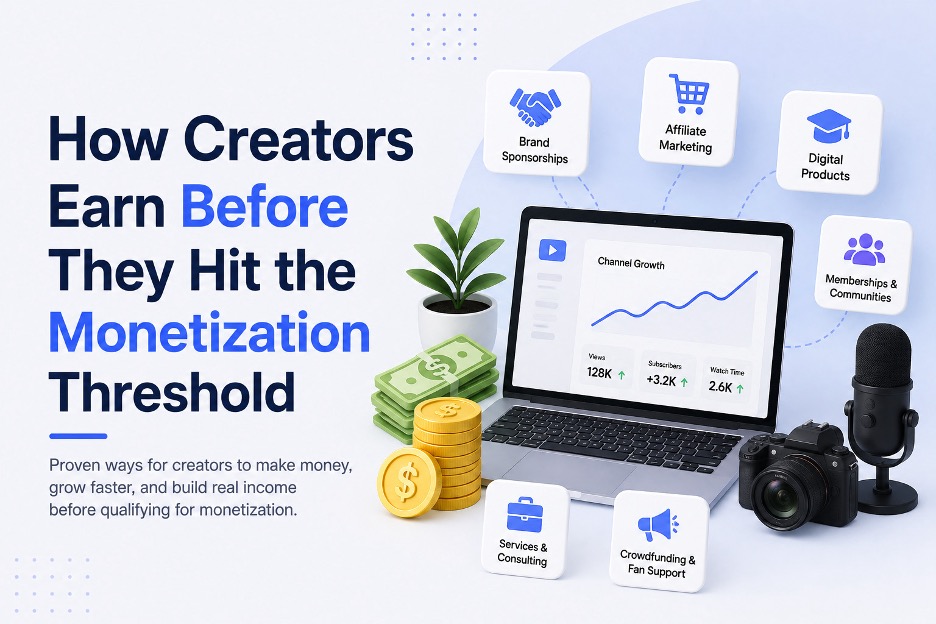
How Creators Earn Before They Hit the Monetization Threshold
You do not need to wait for YouTube monetization to turn an audience into income.
Creators can earn money before joining the YouTube Partner Program (YPP), but not through standard YouTube ad revenue.
That distinction is important.
The YouTube Partner Program controls access to YouTube’s own monetization features, including advertising revenue. It does not stop a creator from earning through sponsorships, affiliate marketing, products, services, or other business models built around their audience.
I have seen creators make the mistake of treating 1,000 subscribers as a finish line. It is not. It is one eligibility milestone within YouTube’s monetization system.
Your audience can have commercial value long before your channel reaches that milestone.
For example, a creator with 700 highly targeted viewers interested in photography equipment may have a more valuable audience for an affiliate offer than a creator with 10,000 viewers who have little purchasing intent.
That is the mindset I recommend: build an audience first, then build several ways to monetize the attention that audience gives you.
If YouTube is part of a broader social growth strategy, YouViews can be one resource to explore, but no external growth tool replaces relevant content, genuine audience interest, or a sustainable monetization strategy.
What Is the YouTube Monetization Threshold?
The phrase “YouTube monetization threshold” can be confusing because YouTube has more than one level of eligibility.
For full YPP access, YouTube currently requires a channel to reach:
- 1,000 subscribers, plus
- 4,000 valid public watch hours during the previous 12 months, or
- 10 million valid public Shorts views during the previous 90 days
Meeting those numbers does not automatically guarantee acceptance. YouTube also reviews channels against its monetization policies and other eligibility requirements.
There is also an earlier-access YPP tier in eligible countries and regions. YouTube says creators can apply with:
- 500 subscribers
- 3 valid public uploads in the last 90 days
- and either 3,000 valid public watch hours in the last 12 months or 3 million valid public Shorts views in the last 90 days
This earlier tier can provide access to features such as channel memberships, Super Chat, Super Stickers, Super Thanks, and Shopping, subject to the relevant requirements.
So when someone asks, “Can I monetize YouTube before 1,000 subscribers?”, the answer depends on what they mean by monetize.
You cannot rely on standard YouTube ad revenue before meeting the applicable YPP requirements, but you can absolutely build revenue around your YouTube audience before then.
For creators focused on building the watch-time side of their channel, remember that legitimate watch-hour growth comes from people actually watching eligible public content. A YouTube watch hours service should never be treated as a substitute for genuine audience development or a guarantee of YPP approval.
1. Brand Sponsorships and Paid Partnerships
Brand deals are one of the most obvious ways creators can earn before YouTube ad monetization.
And you do not necessarily need tens of thousands of subscribers.
Brands care about the audience you can reach, the relevance of that audience, the quality of your content, and whether people trust your recommendations.
A small channel can be attractive to a company if it serves a highly specific niche.
Imagine a YouTube channel with 2,000 subscribers focused entirely on home espresso machines. A coffee equipment company may find that audience much more valuable than a general entertainment channel with 20,000 subscribers.
Potential sponsorship formats include:
- Dedicated sponsored videos
- Product integrations
- Tutorials featuring a product
- Product reviews
- Sponsored mentions
- Demonstrations
- Brand ambassador arrangements
YouTube also provides tools and policies around paid product placements, sponsorships, and other commercial relationships, so creators need to disclose paid promotions appropriately.
Case Study: The Niche Creator Success
Consider a travel photographer who started a YouTube channel with only 800 subscribers. Instead of waiting for ad revenue, they created a high-quality, 10-page ‘Travel Photography Gear Guide’ (a digital product) and partnered with a specialized camera bag manufacturer for a dedicated review video. By focusing on their specific niche and providing genuine value, the creator earned more from their affiliate links and the digital guide in their first three months than they would have earned from ad revenue on a channel ten times their size. This demonstrates that audience relevance and trust, not just subscriber numbers, drive early monetization.
My advice is to avoid approaching brands with nothing but your subscriber count.
Instead, prepare:
- Your niche
- Average views
- Audience demographics
- Engagement
- Typical video topics
- Examples of your best-performing content
- A clear sponsorship offer
That turns “I have a YouTube channel” into an actual media proposition.
2. Affiliate Marketing
Affiliate marketing is particularly useful for creators whose content naturally involves products, tools, software, equipment, or services.
The model is simple:
Video → recommendation → affiliate link → purchase → commission
You might review a microphone, demonstrate editing software, compare cameras, recommend books, or explain which productivity tools you use.
If someone clicks your affiliate link and makes a qualifying purchase, you can receive a commission according to that affiliate program’s terms.
Amazon Associates is one well-known example, but creators can also work directly with software companies, online retailers, education platforms, SaaS companies, and specialist affiliate networks.
The important part is intent.
A video titled “My 5 Favorite Cameras for Travel” naturally creates opportunities for product recommendations. A random affiliate link added to an unrelated video does not.
I recommend measuring affiliate performance using:
Clicks × conversion rate × commission = estimated affiliate revenue
That gives you a much clearer picture than subscriber count alone.
3. Sell Your Own Products or Services
This is one of the most overlooked pre-monetization strategies.
If you have expertise, YouTube can function as a lead-generation channel.
You might sell:
- Consulting
- Coaching
- Freelance services
- Photography
- Design
- Editing
- Courses
- Templates
- Ebooks
- Digital downloads
- Workshops
- Memberships hosted outside YouTube
Consider a freelance SEO specialist who publishes videos explaining keyword research.
They do not need to wait for 1,000 subscribers before making money.
One viewer could discover a tutorial, visit the creator’s website, book a consultation, and become a $500 client.
That single conversion could be worth more than thousands of ad-supported views.
This is why I encourage creators to ask:
“What problem does my audience have that I can solve?”
The answer may reveal a stronger business model than advertising.
4. Build a Membership or Community Outside YouTube
Some audiences are willing to pay for access to deeper content, community, or direct interaction.
Creators can build communities through external membership platforms or their own websites.
Possible benefits include:
- Exclusive content
- Private communities
- Group calls
- Tutorials
- Behind-the-scenes material
- Downloadable resources
- Early access
- Direct Q&A
There is an important distinction here.
An external membership platform is not the same as YouTube’s own channel membership feature. YouTube channel memberships are part of its platform monetization system and have their own eligibility requirements.
That distinction prevents one of the most common misunderstandings about pre-monetization income.
5. Create a Revenue Strategy Around Your Niche
There is no universal best monetization method.
The right model depends on your audience.
| Creator type | Strong pre-monetization option |
| Tech creator | Affiliate marketing |
| Beauty creator | Affiliate marketing + sponsorships |
| Business creator | Consulting |
| Fitness creator | Coaching + digital products |
| Educator | Courses + memberships |
| Gaming creator | Sponsorships + affiliate offers |
| Photographer | Services + presets |
| Finance creator | Education + relevant services |
| DIY creator | Affiliate marketing + products |
| Entertainment creator | Sponsorships + licensing |
The common mistake is trying to use every monetization method simultaneously.
I prefer starting with one.
Build content around a commercially relevant audience, test one revenue stream, measure results, and expand only after you understand what works.
How Many Subscribers Do You Need to Make Money?
There is no universal subscriber count required to make money from a YouTube channel outside YouTube’s own monetization features.
This is one of the most important points in the entire article.
A creator with 500 subscribers can potentially earn from services, sponsorships, affiliate sales, or products.
A creator with 50,000 subscribers can earn very little if the audience is disengaged or commercially irrelevant.
Think about the difference between audience size and audience value.
Audience size tells you how many people you can potentially reach.
Audience value considers:
- Relevance
- Trust
- Engagement
- Purchasing intent
- Geographic market
- Niche
- Problem awareness
- Relationship with the creator
For many creators, 1,000 highly relevant subscribers are more useful than 10,000 random viewers.
How Much Can a Creator Make Before YouTube Monetization?
There is no reliable universal figure.
Anyone promising that a channel with a certain number of subscribers will automatically earn a specific amount is oversimplifying creator economics.
Your potential revenue depends on the monetization model.
For affiliate marketing:
Revenue = clicks × conversion rate × commission
For a service business:
Revenue = qualified leads × conversion rate × average customer value
For sponsorships:
Revenue = number of deals × negotiated fee
For digital products:
Revenue = visitors × conversion rate × product price
These formulas are more useful than generic claims such as “You can make $1,000 with 1,000 subscribers.”
Two channels with identical subscriber counts can have completely different economics.
What Counts Toward YouTube’s Watch-Hour Threshold?
If your goal is eventually to qualify for full YPP access through long-form content, you need to understand what YouTube considers eligible watch time.
YouTube states that valid public watch hours come from public long-form videos. Watch hours from private videos, unlisted videos, deleted videos, ad campaigns, YouTube Shorts, and certain other sources do not count toward the 4,000-hour requirement.
This is why creators should build their watch-time strategy around eligible content rather than chasing an arbitrary view number.
You should also remember that reaching the numerical threshold is only part of YPP eligibility. YouTube reviews channels for compliance with its monetization policies.
The Pre-Monetization Creator Revenue Ladder
When I build a creator growth strategy, I think about monetization as a ladder rather than a single switch.
Stage 1: Build attention
Create useful or entertaining content for a specific audience.
Stage 2: Build trust
Give people a reason to return to your channel.
Stage 3: Create a conversion path
Send interested viewers toward an appropriate product, service, affiliate offer, community, or email list.
Stage 4: Add platform monetization
Once eligible, activate the relevant YouTube Partner Program features.
Stage 5: Diversify
Do not allow your entire business to depend on one revenue source.
This model is more resilient because YouTube ad revenue becomes one component of the business rather than the entire business.
How to Start Making Money Before You Reach the Threshold
If your channel is still small, I would not try all nine strategies above.
Start with these five steps:
1. Define your audience.
Know exactly who your videos are for.
2. Identify their commercial problems.
What do they already spend money trying to solve?
3. Choose one monetization model.
Start with sponsorships, affiliate marketing, services, products, or another relevant option.
4. Create content that naturally connects to the offer.
Do not force a sales pitch into unrelated videos.
5. Measure business results.
Track clicks, leads, conversions, revenue, and returning viewers, not just subscribers.
This is how I would approach a channel from zero today.
The goal is not to wait until YouTube says you are ready to make money.
The goal is to build an audience that is valuable enough to monetize responsibly, then use YPP as another layer when you qualify.
Final Takeaway
The YouTube monetization threshold is a platform milestone, not a business starting line.
Creators can build income before YPP through sponsorships, affiliate marketing, services, digital products, memberships, licensing, and other audience-based business models.
The strongest strategy is to stop asking, “How many subscribers do I need?” and start asking, “What does my audience need, and what valuable solution can I provide?”
That shift turns YouTube from a platform you are waiting to monetize into an audience-building asset you can start building a business around today.
FAQs
1. Can you make money on YouTube before monetization?
Yes. You can earn through sponsorships, affiliate marketing, products, services, digital products, external memberships, and licensing before qualifying for YouTube’s advertising revenue.
2. Does YouTube pay you before you reach 1,000 subscribers?
Standard YouTube ad revenue requires eligibility for the relevant YouTube Partner Program tier. However, you can earn independently from your YouTube audience through external revenue streams before reaching 1,000 subscribers.
3. How can I make money on YouTube without 1,000 subscribers?
You can use affiliate marketing, sponsorships, consulting, coaching, digital products, services, memberships, or other business models that do not depend on YouTube ad revenue.
4. Can a small YouTuber get sponsorships?
Yes. Smaller creators can attract sponsors when they have a relevant, engaged audience. Niche expertise and audience fit can be more valuable to a brand than raw subscriber numbers.
5. How many subscribers do you need to make money on YouTube?
There is no universal number for making money outside YPP. You can potentially earn with a few hundred highly targeted subscribers if you have an appropriate product, service, affiliate offer, or sponsorship opportunity.
6. What is the YouTube monetization threshold?
For full YPP access, YouTube currently requires 1,000 subscribers plus either 4,000 valid public watch hours in the previous 12 months or 10 million valid public Shorts views in the previous 90 days, subject to YouTube’s eligibility and policy requirements.
7. Can you join YouTube’s Partner Program with 500 subscribers?
In eligible regions, creators can access an earlier YPP tier at 500 subscribers if they also meet YouTube’s additional upload and watch-hour or Shorts-view requirements. This tier provides access to certain fan-funding and Shopping features rather than the full advertising revenue package. (YouTube Help)
8. How do YouTubers make money before monetization?
Common methods include brand sponsorships, affiliate marketing, selling products, selling services, digital products, memberships, crowdfunding, and licensing original content.
9. Do YouTube views make money if you are not monetized?
Views alone do not automatically generate standard YouTube advertising revenue for a channel that is not eligible for the relevant YPP advertising features. However, those views can generate indirect revenue through sponsorships, affiliate links, products, services, and other business models.
10. How much money can 1,000 YouTube subscribers make?
There is no fixed amount. Revenue depends on the niche, audience engagement, purchasing intent, monetization method, conversion rates, sponsorship rates, and product or service prices.
11. Do Shorts watch hours count toward 4,000 watch hours?
No. YouTube says watch hours from Shorts viewed in the Shorts Feed do not count toward the 4,000 valid public watch-hour requirement for the full YPP threshold. (YouTube Help)
12. What is the best way to make money before YouTube monetization?
The best method depends on the channel. Affiliate marketing works well for product-focused content, services work well for experts, digital products suit educational creators, and sponsorships can work well for creators with a clearly defined niche and engaged audience. The strongest approach is usually to start with one model that naturally fits the audience rather than trying to monetize every video.