
Electric Bike for Delivery Work: Compare Uptime, Cargo, and Service Support
When you’re out delivering food, groceries or small parcels an e-bike is more than just a way of getting around. It’s part of your kit. If the battery dies half way through the shift, the rear rack won’t cope with an order or a worn brake will keep you off the road and you’re going to lose working time.
The ideal electric bike for delivery work will have sufficient real world range to get you through a full shift, be able to safely carry your typical order load and be easy to maintain when the bits start to wear. Motor power is important but range planning, cargo capacity and access to service can have a far greater impact on your day to day productivity.
Here’s what to look at when choosing a delivery bike, with the Leoguar Sprint (a utility model) in that context.
What Matters Most in an Electric Bike for Delivery Work?
Delivery riding places very different demands on a bike than occasional recreational use. The constant stopping and starting, the repeated acceleration, the extra load and the long hours on the road can all contribute to increased battery consumption and wear on the tires, brakes and drivetrain.
Start by evaluating these five factors:
| Priority | What to Check | Why It Matters |
| Battery and Range | Usable range under your expected load | Helps prevent running out of power mid-shift |
| Cargo Capacity | Total payload and individual rack limits | Keeps orders within the bike’s rated limits |
| Reliability | Component quality and maintenance needs | Reduces avoidable downtime |
| Service Support | Replacement parts, warranty, and repair access | Helps you return to work sooner |
| Fit and Comfort | Riding position, weight, and handling | Matters during long shifts and frequent stops |
A bike with a very respectable range on paper isn’t necessarily the best delivery bike. What’s important is can it actually do your route, can it safely carry your orders and can it be relied upon when something does go wrong?
How Much Battery Range Do You Need for Delivery Work?
Choose your best e-bike based on the total distance of your shift (not just the claimed maximum range). Your total shift distance will be the distance to your delivery area, the distance between all your pick-ups and drop-offs, the repositioning and the distance back home.
For instance, a rider might ride 5 miles to the delivery area, 20 miles to complete the orders, 4 miles to reposition and 5 miles back home. That’s 34 miles before you even start to factor in detours and the like.
A practical planning method is to work out your total distance and then add a planning margin of 20-30% as a starting point. That’s a planning margin, not a guarantee that you’ll have sufficient range in all the conditions.
What Reduces Delivery Range?
Several factors can increase energy consumption during a delivery shift:
- Frequent stops: repeated acceleration uses energy (particularly when you’re carrying a load).
- Heavy orders: more combined weight will mean more power required to accelerate and to climb.
- Hills and headwinds: both can have a significant effect on motor demand.
- High assistance or throttle use: higher motor output will generally consume more energy.
- Cold weather and tire pressure: low temperatures and under inflated tires will all reduce practical range.
If your normal shift is in the bike’s expected range then you could look at charging during a break or using an approved spare battery if one is available from the manufacturer. Don’t just assume that a removable battery can be swapped in for any battery of the same voltage.
How Much Cargo Can a Delivery Electric Bike Carry?
Check the total payload and the maximum load allowed on the rack separately. Total payload will usually be rider and cargo only. The rack will have its own load limit as well and that too must be adhered to.
Suppose the bike has a 275lb total payload. The rider is 190lb, clothing and equipment 10lb so only 75lb is left for orders and other cargo under that limit. If the rack has a lower rating then the rack’s rating will apply as well.
| Cargo Check | What to Confirm |
| Total Payload | Rider, clothing, equipment, and orders stay within the rated limit |
| Rear Rack Rating | The load on the rack does not exceed its individual limit |
| Mounting Compatibility | The delivery box or bag is approved for the rack |
| Load Distribution | Cargo is secured and balanced |
| Handling and Braking | The loaded bike remains controllable and can stop safely |
A delivery bag must be properly mounted and positioned so as not to interfere with the rider, the lights, the brakes or the wheels. Don’t stack your orders so high or so wide that they catch the wind or make the bike unstable.
For larger food orders or grocery deliveries a proper cargo bike may be the better option than a standard utility bike. The right bike is going to be the one that can cope with your largest load, not simply the one that will do the average order.

Is a More Powerful Motor Better for Delivery Work?
Motor power has an effect on both acceleration and the ability to maintain assistance, but power in watts alone doesn’t dictate the delivery. Torque, gearing, controller programming, total load and terrain all play a part.
A bike used for flat city riding with light food orders has very different requirements to one that’s being used to carry groceries up steep hills. A more powerful motor may be of benefit in the latter case, but it will also tend to consume more energy if you’re using it in an aggressive manner.
For a lot of starts and stops look at how smoothly the motor responds and whether the gearing is such that you can pedal comfortably under load. Test it with a load that is representative of what it will actually be used with and that stays within its rating. Make sure the motor setup is in compliance with the local e-bike rules.
How Can You Keep an Electric Bike Available for Every Shift?
Uptime is all down to preventive maintenance and how quickly you can get a problem sorted when it arises. For delivery riders in particular a small mechanical fault can end up costing more than the cost of the repair if it’s going to interrupt a shift.
Create a short pre-shift inspection routine:
- Check the tires: look for cuts, embedded debris, low pressure and any visible damage.
- Test the brakes: make sure both of them are working properly and that the levers are both in the same ballpark.
- Inspect the drivetrain: the chain, the shifting and any odd noises.
- Check the battery: make sure it’s sufficiently charged for the route you’re taking and check the battery case.
- Test the lights (front and rear) particularly as you’ll be doing deliveries in the evening.
- Secure the cargo setup: check the straps, the rack fasteners and the load stability.
During the week clean and lubricate the drivetrain as required, check brake pad wear and nip any minor issues in the bud before they turn into major repair jobs. Stick to the manufacturer’s maintenance schedule rather than go with a set service interval for everything.
It’s also worth having some basic repair kit items on hand such as a compatible tube or puncture repair kit, tire levers and a portable pump. They won’t fix everything but may be of use in dealing with minor roadside problems.
Why Service Support Matters as Much as Battery Range
A delivery bike is only of any use when it’s actually available to ride. Before you buy one you should check whether the manufacturer offers replacement batteries, brake bits, tires, chargers and the various bits and pieces that are specific to the model.
Ask about how warranty claims are processed, whether electrical work has to be done by an authorised service provider and whether common wear items can be repaired by a local bike shop. Find out if the warranty covers commercial delivery use (you can’t assume a consumer warranty will cover all forms of commercial use).
| Service Factor | Questions to Ask |
| Warranty | Does coverage apply to your intended use? |
| Replacement Parts | Are compatible batteries, chargers, and wear parts available? |
| Repair Options | Can a local shop service the bike? |
| Support Response | How do you report a fault and obtain troubleshooting help? |
| Downtime Planning | Can you arrange backup transportation if the bike needs repair? |
If delivery is your main source of income then the cost of downtime is a factor you need to consider when choosing a bike. A cheaper bike may not be the best value if the parts are hard to source or if the bike takes a long time to repair.
Leoguar Sprint: A Utility Electric Bike for Local Deliveries
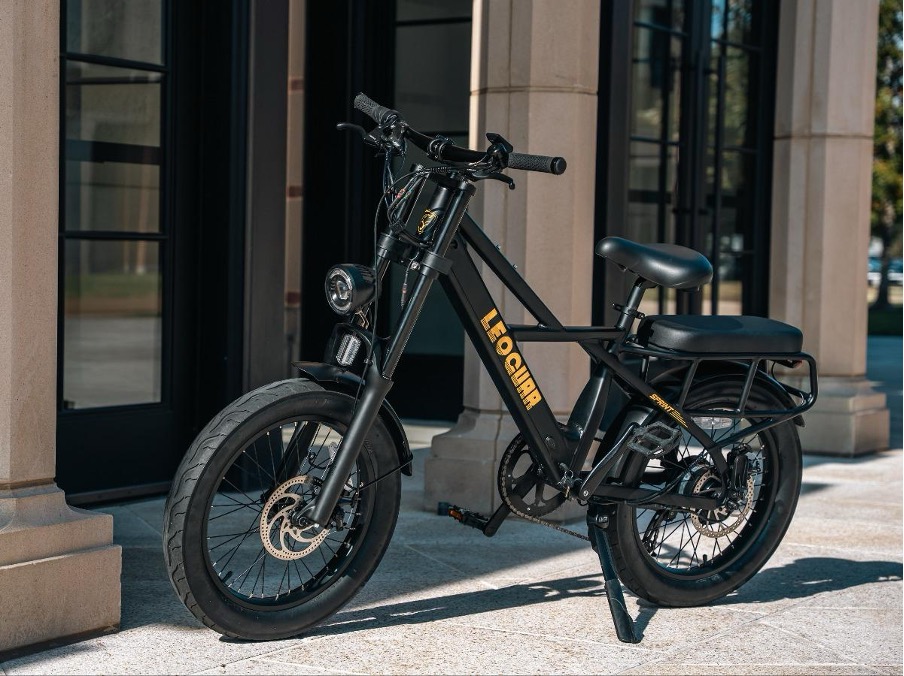
For riders doing local food orders, small packages and the like the Leoguar Sprint fat tire utility electric bike is definitely worth a look.
Sprint is a commuting/utility bike with a 350W rated rear hub motor, a removable 614Wh battery, 5 levels of pedal assist, a half twist throttle and Shimano 7 speed gearing. The range claimed is up to 55 miles (under ideal conditions) although the actual range you’ll achieve will be highly dependent on stops, load, speed, hills and throttle usage.
The integrated 3-in-1 rear mount takes compatible cargo or passenger accessories. For delivery work you could well find a suitable cargo bag or box makes it much easier to get around with small orders (again provided the installation is in accordance with the accessory manufacturer’s instructions).
Sprint Specifications for Delivery Riders
| Feature | Leoguar Sprint |
| Rated Motor | 350W rear hub motor |
| Battery | 614Wh removable battery |
| Advertised Range | Up to 55 miles |
| Tires | 20 × 3.0 inches |
| Gearing | Shimano 7-speed |
| Total Payload Limit | 275 lb, including rider and cargo |
| Rear Carrier Limit | 55 lb |
| Brakes | Mechanical disc brakes, 180mm rotors |
| Bike Weight | 55 lb, including battery |
| Battery Certification | UL 2271 |
Sprint’s removable battery is of course a real plus when you’re looking to charge up between shifts. The 20″ wheels and utilitarian frame are ideal for city riding and light mixed surface work. The 55lb bike weight is also something to bear in mind if you’re going to be lifting it into storage or moving it between jobs.
The bike is not in any way a replacement for a proper heavy duty cargo bike. The 275lb total payload (rider plus cargo) applies and the 55lb rear carrier limit must be adhered to. The mechanical disc brakes also need regular checking, especially if the bike is being used frequently under load.
The advertised 55 mile range should not be taken as your guaranteed delivery shift range. If you’re doing a lot of long routes, heavy loads and/or hills then you’ll need to test your own expected usage and have sufficient reserve to get back safely.
Before you buy, check with Leoguar to confirm the current specification, warranty and availability of replacement parts. If you’re looking at it for professional delivery use, be very clear that your proposed commercial use is in fact covered.

How to Calculate the Cost of Delivery Bike Ownership
The purchase price is just one element of the operating cost. Delivery riders will have to factor in electricity, regular maintenance, tires, brake pads, accessories and the occasional repair.
A simple monthly budget can include:
- Electricity: Work out your charging cost by looking at your battery capacity and your local electricity rate.
- Wear items: allow for tires, tubes, brake pads and drivetrain wear based on mileage.
- Repairs: set aside some money for the odd mechanical or electrical problem that may arise.
- Security: Have a suitable lock and appropriate insurance.
- Downtime: the cost of lost shifts if the bike is out.
You can compare two bikes by working out the cost per working mile or per completed shift. Take your monthly ownership costs and divide that by the number of miles you ride for work. That gives you a fairly straightforward indication of whether a larger battery or more expensive component package is actually going to be worthwhile for your route.
Don’t just go for the lowest purchase price. A bike that’s suited to your workload, has readily available spares and is one that you can reliably maintain may in fact be the better value in the long run.
Final Thoughts: Choose for Uptime, Not Just Specs
The best e-bike for delivery work is the one that will get you through your normal shift, carry your orders (within the safe limits of course), and can be fixed without any undue delay. You start with your actual daily distance and load requirements and then look at battery range, brakes, maintenance and service.
A utility model like the Leoguar Sprint might be quite suitable for local deliveries with modest loads, but for those doing longer distances or carrying heavier loads then you may well want to consider whether a dedicated cargo bike or a second approved battery is the better option.
Before you buy, check the payload figures, the commercial warranty terms and the availability of spares. Those are the details which are going to have a far greater impact on delivery uptime than any one headline spec.
Frequently Asked Questions
1. What is the best electric bike for delivery work?
The best e-bike for you is going to be determined by your route, your shift length, the weight of your cargo and your access to repair facilities. You need sufficient real world range with a buffer, a suitable cargo solution, good brakes and access to spares. If you’re doing heavy or bulky deliveries then you may well need a dedicated cargo bike.
2. What range does an e-bike need for food delivery?
Estimate the full distance of your shift, including travel to the delivery area, trips between orders, repositioning, and the return journey. Add a reserve for detours and changing conditions. A bike’s advertised maximum range is not a guarantee of the distance it can cover under delivery loads.
3. Can I use a regular electric bike for delivery work?
Yes, for smaller orders and manageable loads, provided the bike’s payload and rack limits are sufficient. Make sure the cargo can be secured without affecting steering, lights, brakes, or wheel clearance. If you regularly carry large orders, a dedicated cargo bike may be safer and more practical.
4. Is the Leoguar Sprint suitable for delivery work?
Sprint may suit local deliveries involving small packages, food orders, and light cargo. It has a 614Wh battery, an advertised range of up to 55 miles, and a 275 lb total payload limit. Actual suitability depends on your shift distance, cargo weight, terrain, and warranty coverage for commercial use.
5. What maintenance should delivery riders perform regularly?
Before each shift, check tire condition and pressure, brakes, battery charge, lights, drivetrain, and cargo mounting. Inspect wear parts regularly and follow the manufacturer’s maintenance schedule. Frequent delivery use can accelerate wear, so address unusual noises, braking changes, or electrical faults before they cause a longer interruption.