No Access Below Your Subfloor? How to Fix Squeaks From Above
A squeak on the main floor with a finished ceiling below, or a slab foundation with nowhere to crawl underneath , the standard advice to “just screw it from the basement” simply doesn’t apply. When there’s no way to get beneath the floor, the fix has to work from the surface you can actually reach, and the right method depends heavily on what kind of flooring is underfoot.
Why From-Above Repairs Are Different (And Trickier)
Every from-above repair carries a constraint that below-access work doesn’t: the joist has to be located blind, the fix has to work through a finished surface rather than exposed framing, and the repair itself needs to be hidden or minimized so it doesn’t leave a visible mark. Below-access work lets you see exactly what’s moving and where. From above, you’re working on inference and careful technique instead.
Locating the Joist Without Seeing It
Before any fastener goes in, the joist needs to be found. Tapping or knocking along the floor in a grid pattern reveals the difference between a solid sound (over a joist) and a hollow one (between joists). A stud finder rated for floor joists can confirm what your ears are telling you, and marking the loudest, most solid-sounding spots gives a clear target before drilling anything. This step matters more here than in any below-access repair, since there’s no second chance to check your work from underneath afterward.
The Fix, By Flooring Type
Hardwood or engineered wood floors respond well to angled pilot holes driven at roughly 45 degrees into the joist, followed by trim screws or a dedicated breakaway-screw kit designed for this exact repair. The screw head gets countersunk below the surface and the hole filled with matching wood putty, leaving little to no visible trace.
Carpeted floors are actually more forgiving than they seem, thanks to breakaway-screw kits built specifically for this situation. These kits guide a screw through the carpet, pad, and subfloor into the joist, then snap the screw head off just below the carpet surface once it’s seated , no pulling up carpet required.
Tile floors are the highest-risk category here. Pulling tile to access the subfloor risks cracking the tile itself or the surrounding grout, and getting a screw through tile without shattering it is genuinely difficult. This is one case where calling in a professional is often the smarter move rather than a DIY attempt.
Laminate floors need a different caution entirely. Laminate is designed to float over the subfloor rather than being fastened to it, so screwing it down usually isn’t the right fix and can void a manufacturer’s warranty. A squeak under laminate more often traces back to the underlayment or an installation gap than to the subfloor connection itself.
When to Call a Professional Instead
If a from-above attempt doesn’t resolve the squeak, if the floor is tile, or if there’s any sign the issue goes beyond a simple squeak , bowing, sagging, or movement that feels structural , it’s worth bringing in a flooring contractor or structural professional rather than continuing to drill blind into a finished floor.
Getting the Fastener Choice Right
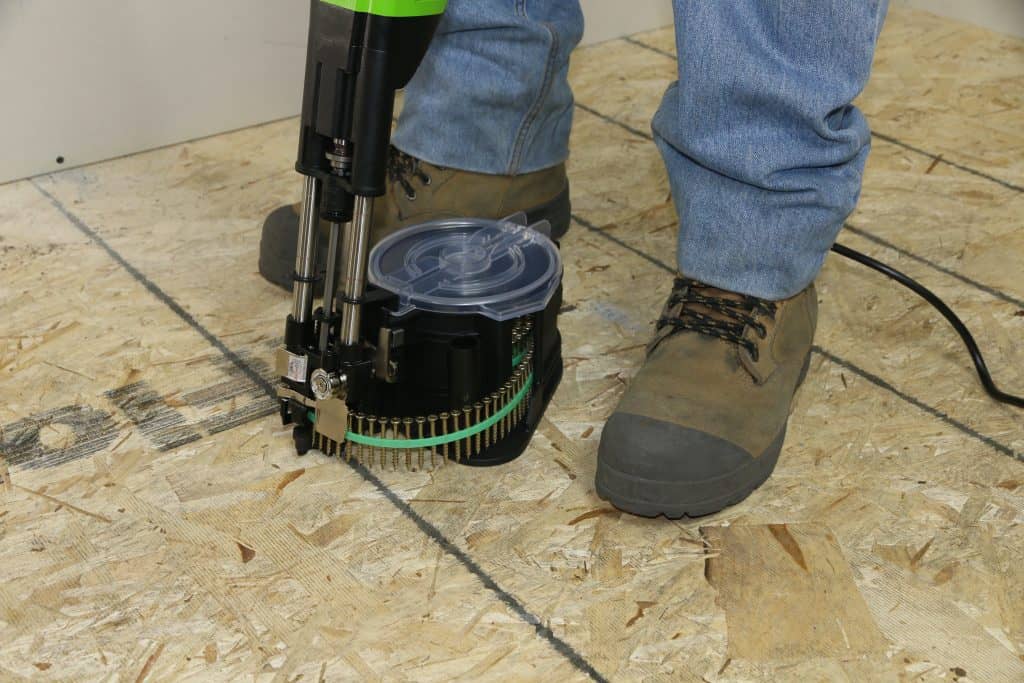
The technique matters, but so does the fastener. A flooring screw gun with reliable depth control makes it far easier to countersink cleanly and consistently on a from-above repair, rather than guessing at pressure with a standard drill. For anyone tackling both an indoor squeak repair and outdoor deck work in the same season, it’s worth knowing that a decking screw gun attachment solves a similar depth-consistency problem outdoors , the underlying principle of controlled, repeatable depth applies whether the fasteners are going into a joist under hardwood or into deck boards outside.
FAQ
Can I fix a squeaky floor without cutting into the finished flooring? Often yes, especially with hardwood or carpet, where a properly placed pilot hole or breakaway-screw kit leaves little to no visible mark.
What’s the best fastener to use for a from-above repair? A trim screw or purpose-built breakaway-screw kit designed to countersink or snap off cleanly below the surface, rather than a standard wood screw.
Is it safe to screw down laminate flooring to stop a squeak? Generally no. Laminate is designed to float, and fastening it down can cause other problems and may affect a manufacturer’s warranty.
How do I find the joist if I can’t see it from below? Tapping in a grid pattern to locate solid versus hollow sound, combined with a stud finder rated for floor joists, is the most reliable approach.
The Bottom Line
No access below isn’t a dead end , it just changes the method. Getting the joist location right and matching the technique to the flooring type on top of it is what makes a from-above repair hold up, rather than just adding another screw and hoping.