8 Ways to Make Money With a Laser Engraver
Laser engraving has become one of the more popular equipment-based side hustles, and the reason is simple economics. A plain wooden cutting board costs a few dollars. Add a family name and a date, and it sells for five to ten times that. The engraving takes minutes, and the material cost barely moves.
That gap between material cost and selling price is what makes the business attractive. But it only turns into income if you pick the right products and price them properly. Here are eight ways people actually earn money with a laser engraver, followed by the money math that decides whether it works.
1. Personalized Gifts
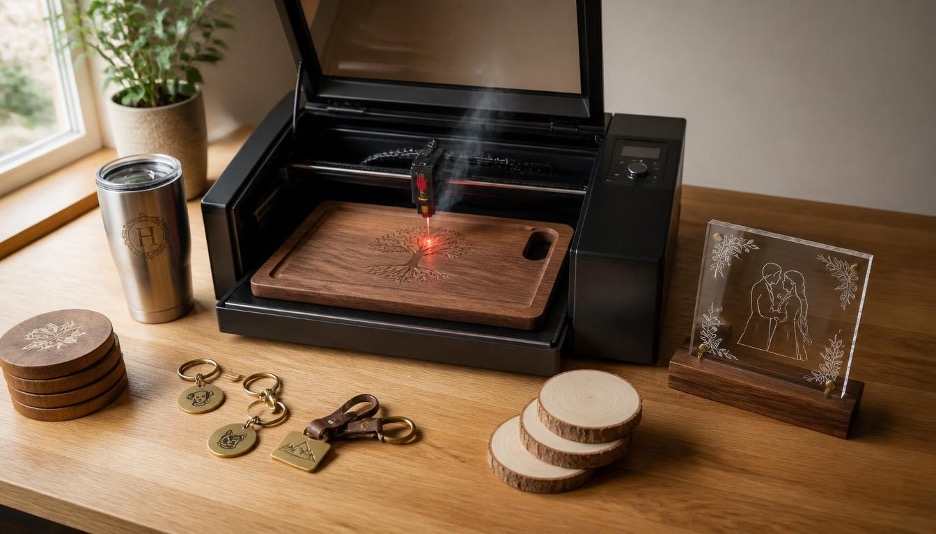
This is the entry point for most people, and for good reason. Engraved cutting boards, tumblers, photo frames, coasters, and jewelry boxes sell steadily year-round and spike around holidays, weddings, and graduations. Blanks are cheap and widely available, the engraving is quick, and customers pay a substantial premium for a name or a date. The downside is competition: this is the most crowded corner of the market, so your listings need to stand out on design or photography rather than price.
2. Wedding and Event Work
Weddings are where personalization budgets are largest and price sensitivity is lowest. Welcome signs, table numbers, place cards, cake toppers, guest books, and favors all engrave well in wood or acrylic. Orders tend to be bulk rather than single items, which improves your earnings per hour considerably. Event planners and venues are worth cultivating as repeat referral sources, since one relationship can produce steady work.
3. Business Signage and Branding
Small businesses need engraved logo signs, door plaques, reception signage, name badges, and branded items. This work pays better than consumer gifts, buyers are less price-focused, and orders repeat as staff change and locations expand. It also tends to be less seasonal than gift work, which helps smooth out income across the year.
4. Corporate and Bulk Orders
Awards, recognition plaques, employee gifts, conference giveaways, and branded merchandise are where the volume is. Per-item prices are lower than one-off consumer sales, but a single order might cover a hundred pieces with one setup, which is far more efficient than a hundred separate customers. Corporate clients also tend to reorder annually, giving you predictable revenue.
5. Pet Tags, Keychains, and Small Items
Small items are underrated. They use minimal material, engrave in a couple of minutes, ship cheaply in a standard envelope, and carry strong margins for their size. Pet tags, keychains, luggage tags, and bag charms are easy add-on purchases and work well as impulse items alongside bigger products. The volume ceiling is high because production time per unit is so low.
6. Home Decor
House numbers, wall art, shelf signs, plant markers, and layered acrylic pieces sell well and let you use larger, higher-priced formats. Decor also gives you room to develop a recognizable style, which is one of the few real defenses against being undercut on price in a crowded market.
7. Seasonal and Holiday Products
Christmas ornaments alone can account for a meaningful share of annual revenue for many small engraving businesses. Ornaments, advent calendars, stocking tags, Valentine’s gifts, and Mother’s Day items all sell in concentrated bursts. The catch is that you must produce ahead of demand rather than during it, so plan inventory months in advance and expect fourth-quarter workload to be heavy.
8. Subcontract Work for Other Businesses
The least visible option is often the most reliable. Trophy shops, print shops, sign companies, woodworkers, and gift retailers frequently need engraving done and do not own a machine. Selling capacity rather than products means no marketing spend, no customer service, no packaging, and repeat orders. Margins per piece are lower, but the volume and consistency often beat retail selling, especially in the early months.
What You Need to Get Started
Nearly all of the products above can be made with a CO2 laser, which handles wood, acrylic, leather, glass, paper, and coated or painted metals. Bare metal marking requires a fiber laser, which is a separate category and only worth considering if metal work is central to your plan. Beyond the machine, a working setup needs fume extraction, design software, and a safe, ventilated space to run it. Buying a quality laser engraving machine from an established supplier matters more than it might seem, because engraving speed directly determines how many items you can produce per hour, and reliable support keeps you earning instead of troubleshooting.
How to Price So You Actually Profit
The most common mistake in this business is pricing against material cost. A $4 cutting board that sells for $35 looks like a $31 profit, and it is not. That figure ignores everything except the blank.
A workable price covers five things: materials, machine time, your labor, a share of overhead, and margin. Labor is the piece people forget, and it is usually the largest. Every order involves customer messages, file setup, machine setup, engraving, finishing, packaging, and a trip to the post office. If a $35 item takes forty-five minutes of your time end to end, you are earning far less per hour than the sticker price suggests.
Decide what your time is worth per hour, measure how long a product genuinely takes, and check that the price clears it. Anything that fails that test should be repriced, redesigned to produce faster, or dropped.
The Costs That Quietly Eat Your Margin
Beyond materials, budget for consumables and replacement parts, electricity, extraction filters, packaging and shipping supplies, and design software. If you sell through an online marketplace, listing and commission fees plus payment processing take a real bite, and on lower-priced items that bite is proportionally larger. Laser tubes also have a finite service life measured in operating hours, so treat replacement as a scheduled cost rather than a surprise.
Add these up monthly and subtract them before you decide what the business is earning. The number that matters is what remains after everything, not what arrives in your payment account.
Is It Worth It?
Laser engraving can be a genuinely profitable side income, and it has real advantages: low material costs, high perceived value, and a wide enough product range that you can shift focus when one market gets crowded. It is not passive income, though. Every sale requires setup, production, and fulfillment, and the businesses that struggle almost always underpriced their own time.
If you want the best odds, start by validating demand before you buy anything, ideally by taking preorders or outsourcing a first batch. Calculate how many sales it takes to recover your startup cost. Then lean toward the higher-volume, lower-competition options such as business signage, corporate orders, and subcontract work rather than competing on price with thousands of other sellers on the same personalized tumbler.