
Wealth Rankings and Business Leaders in the Middle East
The Middle East is home to some of the world’s most dramatic concentrations of wealth. You have Gulf dynasties built on oil, sovereign funds running trillions of dollars, and then a separate story altogether: business leaders of Iranian origin who built their fortunes abroad, often starting from scratch after leaving a country under sanctions. Put all of this together and you get a region where wealth is shaped by geography, geopolitics, and individual ambition in roughly equal measure. This article looks at who sits at the top, with a focus on the Iranian side of the picture.
The Gulf States: Where Oil Built the Rankings
Saudi Arabia, the UAE, and Qatar account for a large chunk of Middle Eastern wealth at the national and individual level. Saudi Aramco alone carries a market cap that puts it among the most valuable companies ever listed. The sovereign wealth funds in the region, Abu Dhabi Investment Authority, Saudi Arabia’s Public Investment Fund, Qatar Investment Authority, collectively manage well over $2 trillion in assets spread across global equities, real estate, tech, and infrastructure.
Individual wealth in the Gulf is often tied to ruling families and their business networks rather than independent entrepreneurs. That makes the region different from the US or Europe, where most billionaires built companies from the ground up. The notable exception is Dubai, which has produced a genuine class of private businesspeople in real estate, logistics, hospitality, and finance, partly because the emirate actively designed itself as a neutral hub.
For traders and investors, Gulf economies matter because they drive oil production decisions through OPEC, hold significant stakes in Western financial institutions, and increasingly invest in technology. When the PIF takes a stake in a company or the QIA shifts allocations, it moves markets.
Iranian Wealth: Two Very Different Stories
Iran presents a split picture. Inside the country, wealth is concentrated around figures with connections to state structures, religious foundations, and major industrial conglomerates. Outside the country, the Iranian diaspora has produced a remarkable cluster of tech and finance billionaires, particularly in the US.
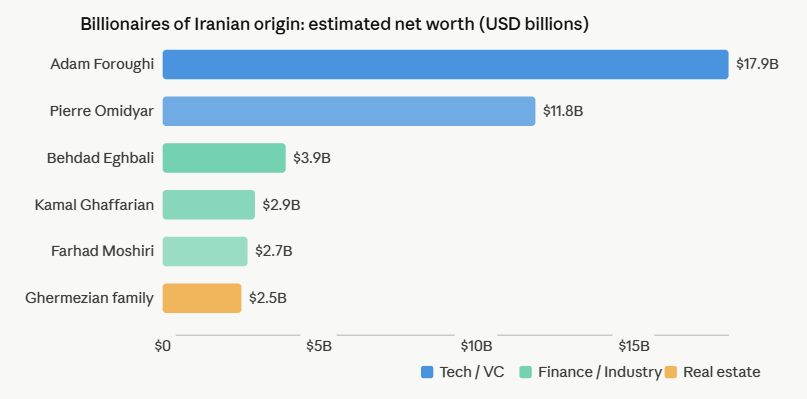
The richest person in Iran by diaspora standards is Adam Foroughi, co-founder and CEO of AppLovin, a mobile marketing and gaming platform. His net worth is estimated at around $17.9 billion, placing him comfortably among the wealthiest individuals of any background in the tech sector. Pierre Omidyar, founder of eBay, comes second at roughly $11.8 billion. Both built their companies in California with no material connection to the Iranian economy.
Inside Iran, the picture is different. Asadollah Asgaroladi, whose business spans agricultural exports, petrochemicals, real estate, and banking, is widely regarded as the wealthiest private businessman operating within the country. His estimated net worth sits between $2.5 billion and $3 billion, a figure that stands out given the economic constraints imposed by years of sanctions and currency volatility.
The Diaspora Billionaires Reshaping Finance and Tech
Beyond Foroughi and Omidyar, several other Iranian-origin figures have built significant positions in finance and industry. Behdad Eghbali co-founded Clearlake Capital, a private equity firm managing tens of billions in assets, and his net worth is estimated at around $3.9 billion. Kamal Ghaffarian built businesses in aerospace and nuclear energy, valued at roughly $2.9 billion. Farhad Moshiri holds stakes in Metalloinvest and became known in the UK for his ownership of Everton Football Club, with a fortune of around $2.7 billion.
The Ghermezian family, who left Iran before the 1979 revolution, built a real estate empire through Triple Five Group that includes some of the largest shopping complexes in North America. Their combined wealth is estimated at $2.5 billion.
What makes this group interesting from a financial perspective is the diversity of sectors. It is not just tech, and it is not just one geography. It spans private equity, aerospace, biotech, real estate, and sports ownership, spread across North America, Europe, and the Gulf.
The table below gives a quick overview of the top names and their sectors:
| Name | Estimated net worth | Sector | Base |
| Adam Foroughi | $17.9 billion | Mobile tech, marketing | USA |
| Pierre Omidyar | $11.8 billion | E-commerce (eBay), philanthropy | USA |
| Behdad Eghbali | $3.9 billion | Private equity (Clearlake) | USA |
| Kamal Ghaffarian | $2.9 billion | Aerospace, nuclear energy | USA |
| Farhad Moshiri | $2.7 billion | Investments, sports | UK / UAE |
| Asadollah Asgaroladi | $2.5-3 billion | Agri exports, petrochemicals | Iran |
What Drives Wealth in the Region
Across the Middle East, a few themes keep coming up. Oil and gas remain the foundation of national wealth in Saudi Arabia, Qatar, and Kuwait. But the story is shifting. The UAE, particularly Dubai and Abu Dhabi, has spent two decades building financial services, real estate, logistics, and tourism into serious economic pillars that attract capital independently of oil prices.
For private individuals, the path to wealth increasingly runs through one of three channels: connections to state resources and contracts, building a business in a high-growth sector like tech or finance abroad, or positioning in real estate at the right moment in a rapidly urbanizing market. The Iranian diaspora billionaires mostly took the second route: leave, build something significant in a liquid market, and let compounding do the rest.
Sanctions have fundamentally shaped who becomes wealthy inside Iran versus outside. Within the country, the most successful businesspeople tend to operate in sectors where state relationships or access to controlled resources matter more than international market access. Outside, the diaspora has been free to compete globally, which is why figures like Foroughi and Omidyar exist at the scale they do.
Conclusion
Middle Eastern wealth is more varied than the headline “oil money” narrative suggests. Gulf sovereign funds and royal family business networks are one layer. Private entrepreneurs in Dubai and Riyadh building real companies are another. And the Iranian diaspora, scattered across Silicon Valley, London, and Toronto, represents a third thread entirely. What connects all of them is a tendency to move capital across borders, take long-term positions, and operate in industries where scale creates a durable advantage. For anyone tracking global capital flows, the Middle East is not a sideshow. It is increasingly one of the places where major decisions about where money goes get made.