How to Layer a Women’s Shearling Vest Without Bulk
A women’s shearling vest can add texture, structure and useful core warmth to a cold-weather outfit without covering the sleeves of everything underneath. The challenge is not the vest itself. Most unwanted bulk comes from combining incompatible sleeves, crowded necklines, stacked waistbands or outerwear that was never designed to accommodate the complete outfit.
The best way to layer a women’s shearling vest is to build the outfit from the inside out. Begin with a smooth, comfortable base, check that the vest has enough room through the chest and armholes, and add a coat or weather-resistant shell only when conditions require it. Every layer should have a clear purpose and enough room to move.
Shearling remains relevant beyond purely practical winter dressing. Vogue’s Fall 2026 coat trend report highlighted a shift toward more structured, shaped shearling silhouettes. A vest offers an accessible way to use that texture while keeping the overall outfit flexible.
The Quick Formula for Layering Without Bulk
For a clean and comfortable outfit:
- Start with a base layer that sits smoothly without feeling restrictive.
- Keep wide sleeves away from narrow armholes.
- Avoid stacking multiple collars, folded hems or thick waistbands in one place.
- Try the vest over the exact sweater or shirt you intend to wear.
- Close the vest, sit down and reach forward before deciding that the fit works.
- Add wind or rain protection when the weather demands more than torso insulation.
- Treat visible volume as a styling choice; restricted movement is the real fit problem.
A layered outfit does not need to look skin-tight to appear polished. The objective is controlled volume, not the elimination of every relaxed shape.
Why Does a Shearling Vest Sometimes Look Bulky?
Shearling and shearling-style materials naturally create more visual depth than a flat woven fabric. Wide collars, exposed trims, substantial closures and structured leather or suede surfaces can also give a vest a stronger outline.
That texture is part of the appeal. Problems usually appear when several sources of volume compete with one another.
A loose shirt sleeve may bunch beneath a fitted sweater. A thick sweater can press against narrow armholes. A shirt hem, folded knit and trouser waistband can all occupy the same area. An oversized collar may then compete with a hood or scarf around the neck.
Instead of deciding that the entire outfit is too bulky, identify the crowded point:
- If the upper arms feel restricted, examine the sleeves and armholes.
- If the waist feels packed, remove an unnecessary tuck or folded hem.
- If the neckline looks busy, simplify either the inner collar or the accessories.
- If the vest pulls across the chest, reconsider its size or the thickness underneath.
- If the outer coat will not close comfortably, simplify the middle layer or choose roomier outerwear.
Correcting the specific pressure point is more effective than replacing every garment with something tighter.
Build the Outfit as a Layering System
Cold-weather clothing works best when each layer performs a distinct function. REI’s cold-weather layering guidance organizes clothing into a base layer, an insulating middle layer and an outer layer for wind and precipitation.
A women’s shearling vest will usually function as an insulating or fashion-focused middle layer. It should not automatically be treated as a complete substitute for weather-resistant outerwear.
The base layer
The garment closest to your body should sit smoothly and remain comfortable when you move. Depending on the outfit and weather, this could be:
- A fitted long-sleeve top
- A fine-knit crewneck
- A lightweight turtleneck
- A smooth button-down shirt
- A breathable thermal layer
“Fitted” does not mean tight. The base should follow the body closely enough to avoid bunching but should not pull across the back, shoulders or underarms.
The vest layer
The vest provides texture and additional torso coverage. Its chest, armholes, neckline and closure must accommodate the base layer without flattening it into uncomfortable folds.
A close-fitting vest can work over a lightweight top. A heavier sweater normally needs a more relaxed vest with sufficient armhole space. The garment’s stated size is only a starting point; the intended combination determines whether the fit is successful.
The outer layer
A coat or shell becomes important when wind, precipitation or extended exposure changes the demands of the outfit. The outer garment should close over both the base and vest without compressing them excessively.
A coat that fits comfortably over a T-shirt may not fit over a knit and shearling vest. Test the complete combination rather than judging each garment separately.
What to Wear Under a Shearling Vest
The best layer under a shearling vest depends on the vest’s fit, the temperature and how much movement the day involves.
Long-sleeve tops for mild weather
A smooth long-sleeve top is the lowest-bulk option. It allows the vest’s collar and texture to remain the focus while providing arm coverage.
Cotton can work for mild, everyday conditions. For more active or colder situations, choose a fabric appropriate to the environment and your personal comfort. The important point is that the top should remain smooth through the shoulders and sleeves.
Fine-knit sweaters and turtlenecks
A fine-knit sweater is one of the most versatile answers to what to wear under a shearling vest. It adds warmth without forcing excessive fabric through the armholes.
A turtleneck creates a clean line beneath open-front, aviator and oversized-collar designs. A crewneck is useful when the vest already has a high or dramatic collar.
Before settling on the combination, turn your head and raise your arms. A visually neat neckline is not useful if the collar presses uncomfortably when you move.
Button-down shirts
A button-down shirt can give a women’s shearling vest a more polished or business-casual direction. Let the collar and cuffs appear deliberately rather than pulling every edge into view.
Straighten the shirt across the back before adding the vest. If the shirt has full sleeves, make sure they are not twisted or gathered beneath the armholes. At the waist, distribute a tucked hem evenly instead of pushing all the fabric into the front.
Hoodies and substantial knits
A hoodie or chunky knit can work when the vest is deliberately roomy. It should not be forced beneath a fitted design simply because both pieces look good separately.
Pull the hood clear of the collar and check that it does not press against the back of the neck. For a heavy knit, close the vest and reach forward. If the armholes pinch or the front gaps noticeably, the combination needs more space.
How Should a Women’s Shearling Vest Fit for Layering?
A successful fit accommodates the intended underlayer while allowing the vest to retain its shape. Try these checks before relying on mirror appearance alone.
Check the chest and closure
Fasten the vest over your normal winter layer. The front should close without strong pulling, gaping or pressure across the chest.
An open-front outfit can be a valid styling choice, but it should not be used to disguise a vest that cannot close when closure is part of its design.
Examine the armholes
Armholes deserve particular attention because they determine what can fit underneath. The edge should not cut into the sweater, restrict circulation or create a thick ridge of trapped fabric.
Raise both arms, reach forward and imitate the movement of driving or carrying a bag. If the vest shifts dramatically or the underlayer bunches, reconsider the pairing.
Sit down
A vest that looks balanced while standing can behave differently when seated. Check whether the hem pushes upward, the collar presses against the neck or the closure becomes uncomfortable.
This test is particularly important for commuting, desk work, dining and travel.
Try the outer coat
If you plan to wear a coat over the vest, test that exact combination. Close the coat, bend your elbows and reach forward.
The outer layer needs enough room through the back, shoulders and sleeves for everything beneath it. Making every inner garment tighter is not a good substitute for outerwear that fits the complete outfit.
How to Balance Different Vest Lengths
There is no single bottom shape that every woman must wear with a shearling vest. Proportion depends on the vest length, fabric movement and the silhouette you want to create.
Cropped shearling vests
A cropped vest naturally emphasizes the waist area. It works particularly well with high-rise jeans, trousers and skirts because the waistband visually connects with the vest’s shorter hem.
A fitted or smoothly tucked top can keep the transition clean. If several layers gather at the waistband, leave one hem untucked rather than forcing everything into the same space.
Hip-length vests
A hip-length vest is the most flexible option for everyday shearling vest outfits. It can work with straight jeans, tailored trousers, leggings, midi skirts and dresses.
Check where the vest ends in relation to pockets and waistbands. If the hem repeatedly catches on them, the outfit may feel awkward even when it looks balanced in a photograph.
Longline shearling vests
A longline vest creates more torso and hip coverage and can function visually like a sleeveless coat. It can be worn over narrow or wide-leg bottoms; neither is automatically correct.
With wider trousers or a full skirt, use a smooth base layer and let the fabrics fall without multiple bulky breaks. Wearing the vest open can create a clear vertical line, but closing it may be preferable in colder or windier conditions.
Oversized silhouettes
An oversized vest does not need to be “corrected” into a smaller-looking shape. Give it enough visual and physical space.
A smoother underlayer can make the oversized cut easier to wear, but the rest of the outfit does not have to be tight. Straight or wide-leg trousers can work when their fabric falls cleanly and the combined outfit remains comfortable.
Four Women’s Shearling Vest Outfit Formulas
Instead of collecting dozens of combinations, begin with four adaptable formulas.
1. Everyday casual
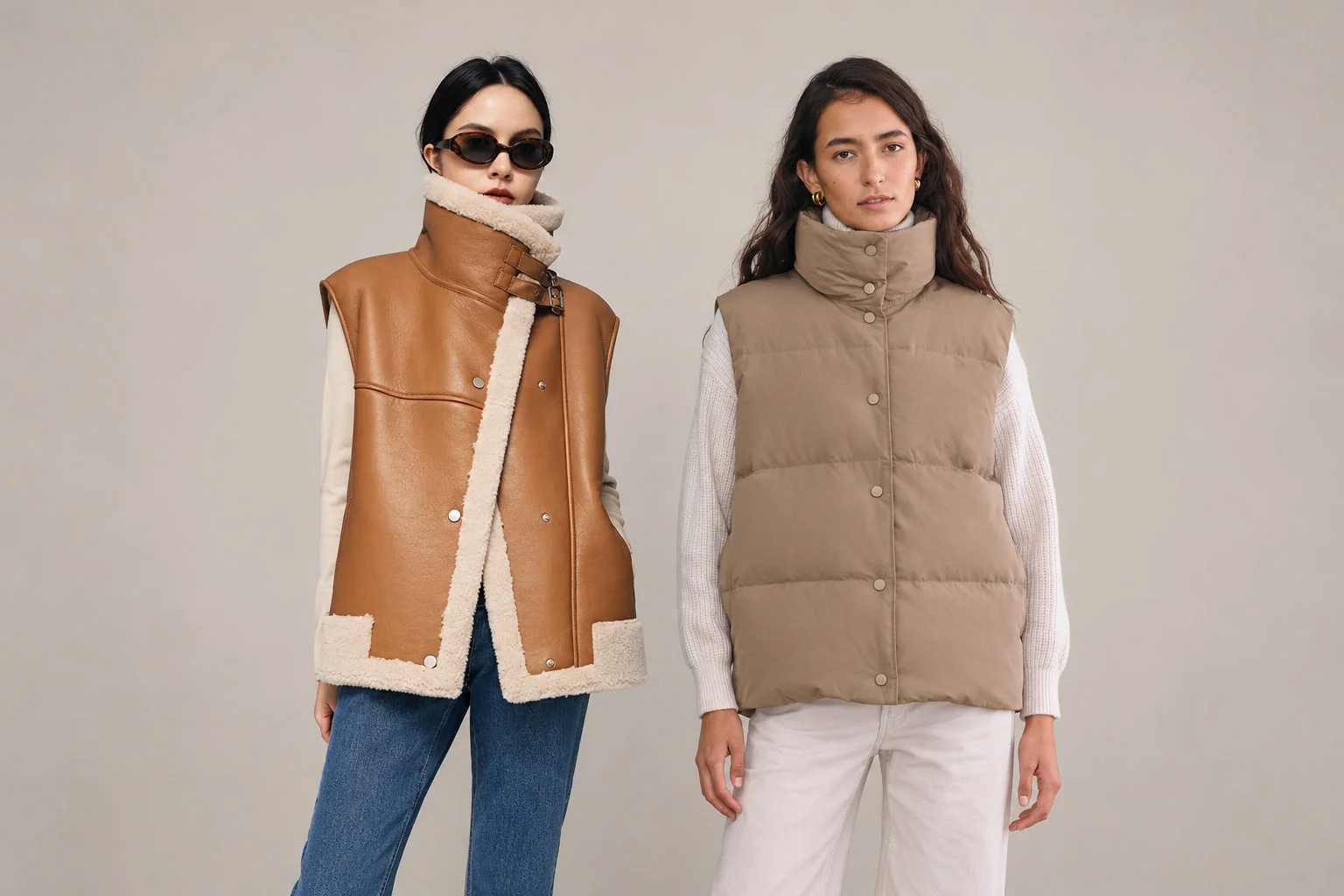
Wear a brown or tan shearling vest over a fine crewneck with straight jeans and ankle boots or clean sneakers.
This combination works because the smooth knit supports the vest’s texture without adding competing volume. Keep the waistband simple and choose a bag that does not repeatedly catch on the vest’s collar or front.
2. Smart casual
Layer a dark, relatively streamlined vest over a lightweight turtleneck or button-down shirt. Add tailored trousers and loafers or polished ankle boots.
Make sure the shirt sleeves sit smoothly and that the vest remains comfortable while seated. This matters more than achieving an artificially narrow outline.
3. Relaxed weekend layering
Combine a roomy shearling vest with a sweatshirt or hoodie, straight joggers or relaxed jeans and practical footwear.
Keep the hood outside the vest and check the back neckline for pressure. If both the hoodie and vest are oversized, allow them to form an intentional relaxed silhouette rather than trying to compress one inside the other.
4. Dress or skirt combination
Wear a hip-length or longline vest over a long-sleeve knit dress, or pair it with a smooth top and midi skirt.
Consider how the vest hem interacts with the dress or skirt. Similar lengths can create a continuous line, while a shorter vest can define the waist. Both approaches can work when the layers move freely.
Open or Closed: Which Looks Less Bulky?
Wearing a vest open exposes the inner layer and can create a longer visual line through the center of the outfit. It also makes temperature adjustment easier when moving between outdoor and indoor spaces.
Closing the vest provides more torso coverage and reveals whether the fit genuinely works. A vest should not pull across the chest or force the base layer into folds.
Use the closure according to comfort, weather and the intended look. “Always wear it open” is not a useful rule, particularly when wind protection or warmth matters.
When a Shearling Vest Is Not the Complete Answer
A sleeveless layer leaves the arms dependent on the garments underneath and around it. During prolonged cold, strong wind or wet weather, a sweater and vest may not provide sufficient overall protection.
Add suitable outerwear when conditions require it. A weather-resistant shell or roomy winter coat can protect the insulating layers beneath it. Adjust the outfit when activity increases so that excessive heat and moisture do not build up inside your clothing.
The decision may also depend on whether you prioritize texture, packability, weather management or ease of care. For a focused breakdown of those trade-offs, consult this women’s shearling vest vs. puffer vest guide. That comparison is more useful than assuming one type of vest is universally better.
Common Shearling Vest Layering Mistakes
Sizing every inner layer down
Tighter clothing does not automatically create a cleaner outfit. A restrictive base can pull when you sit, while a tight sweater can make the vest’s armholes feel even smaller.
Choose compatible shapes instead of relying on smaller sizes.
Ignoring sleeve volume
A wide inner sleeve has to gather somewhere when it enters a narrow outer sleeve or armhole. If bunching persists, move the fuller garment outward in the layering order or select a roomier vest.
Stacking too much at the waist
A tucked shirt, folded sweater and trouser waistband can form one dense band. Remove an unnecessary tuck or let one hem fall naturally.
Crowding the neckline
A shirt collar, turtleneck, large shearling collar, hood and scarf may all compete for the same limited space. Decide which one or two elements should lead.
Judging the outfit only while standing
Real outfits need to work while sitting, reaching, walking and carrying everyday items. Movement testing exposes fit problems that a front-facing mirror does not.
Dressing for appearance instead of weather
A low-bulk outfit should still be appropriate for the conditions. Add arm coverage, wind protection or rain protection when required rather than sacrificing comfort for a narrower silhouette.
A Final Low-Bulk Layering Checklist
Before leaving home, ask:
- Does the base layer sit smoothly across my back and underarms?
- Can the vest close without pulling or gaping?
- Do the armholes remain comfortable when I reach forward?
- Are multiple hems or waistbands stacked in one place?
- Can I sit comfortably in the complete outfit?
- Does my coat close over the vest if I need one?
- Is the outfit suitable for the wind, moisture and time outdoors?
- Can I remove or open a layer if indoor temperatures rise?
If the answer to these questions is yes, the outfit is doing more than looking polished—it is functioning properly.
Frequently Asked Questions
What should you wear under a women’s shearling vest?
A fitted long-sleeve top, fine-knit sweater, lightweight turtleneck or smooth button-down shirt can all work. Choose the underlayer according to the vest’s armhole space, temperature and intended activity.
How do you layer a shearling vest without looking bulky?
Keep the base layer smooth, avoid wide sleeves inside narrow armholes and prevent several folded hems from occupying the same part of the waist. Test the completed outfit while seated and with your arms extended.
Should you size up a shearling vest for layering?
Do not size up automatically. Try the vest over the thickest garment you realistically plan to wear, then check the chest, closure, armholes and movement. Use the seller’s garment measurements rather than relying only on your usual size.
Can you wear a shearling vest under a coat?
Yes, provided the coat has enough space through the shoulders, back and sleeves to close comfortably over the complete outfit. Test the coat over the actual vest and underlayer before relying on the combination.
Can a shearling vest be worn with wide-leg trousers?
Yes. A smooth inner layer and clean fabric drape can balance a textured vest with wide-leg trousers. Slim bottoms are an option, not a universal requirement.
Is a shearling vest warm enough for winter?
It can be part of a winter layering system, but its effectiveness depends on construction, coverage, underlayers, activity and weather. Sleeveless insulation may need to be combined with a sweater and suitable outerwear during severe cold, wind or precipitation.
Final Thoughts
Learning how to layer a women’s shearling vest without bulk is less about rigid fashion rules and more about garment compatibility. A smooth base, suitable armhole space, controlled waist volume and outerwear that fits over the entire combination will make a greater difference than forcing every piece into a tighter silhouette.
Choose layers that remain comfortable while you sit, walk and reach. Let cropped, longline and oversized vests create different proportions without treating one body shape as the standard. Most importantly, dress for the actual conditions.
When every layer has a purpose and enough room to perform it, a women’s shearling vest becomes an adaptable part of a cold-weather wardrobe rather than a difficult statement piece.