

How a CRM for OnlyFans Helps You Increase Sales
Most OnlyFans money is not made when a fan subscribes. It is made later, in the chat. Industry data from chatting agencies puts 50 to 70 percent of a top creator’s revenue in direct messages, from pay-per-view content, tips, and custom requests. So if your DMs are messy, your income is leaking. This guide shows how a CRM for OnlyFans fixes that leak and turns random chats into steady, repeatable sales. By the end, you will know exactly which features move the needle and how to start using them.
What a CRM for OnlyFans actually is
CRM stands for Customer Relationship Management. In plain words, it is software that keeps track of every fan and every conversation in one place. A normal business uses a CRM to manage leads and customers. On OnlyFans, your “customers” are your fans, and your sales floor is the chat.
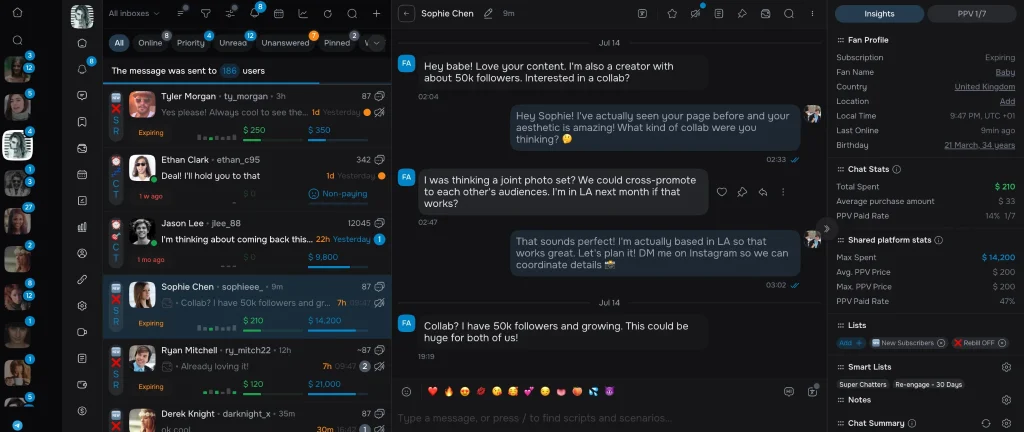
A general CRM like Salesforce or HubSpot was not built for this. It does not connect to OnlyFans, it does not understand PPV, and it cannot handle a team of chatters working many creator accounts at once. That is why purpose-built tools like AgencyKey exist for OnlyFans agencies. They sit on top of the OnlyFans inbox and add the missing layer: fan history, spending data, saved templates, mass messages, and reporting.
The payoff is not small. Across industries, businesses that use a CRM report about a 29 percent lift in sales and a 34 percent boost in sales productivity. The reason is simple. When you stop guessing and start working from data, you sell more with the same number of hours.
Why the real money lives in the DMs
Let us look at how a top creator’s income breaks down. Subscriptions usually bring only 15 to 30 percent of gross revenue. Pay-per-view content sold inside chats brings 50 to 70 percent. Tips and customs fill the rest. So the subscription is just the front door. The chat is where the buying happens.
This matters because the OnlyFans market is crowded. The platform had around 4.6 million creators in 2025, up from 348,000 in 2019. That is more than a 1,200 percent jump in six years. With 377 million registered users and over 620,000 new sign-ups every day, there is plenty of demand. But attention is split across millions of accounts, and the top 1 percent of creators pull in roughly a third of all revenue. To compete, you cannot rely on luck in the inbox.
Here is the problem a CRM solves. A busy account can hold thousands of fans. A human chatter cannot remember who spent 500 dollars last month, who only tips on weekends, and who has never bought anything. Without a system, your team treats a whale and a freeloader the same way. That is how you burn out big spenders with the wrong offer and waste hours on people who will never pay.
Fan profiles: knowing who is worth your time
The first job of a CRM is memory. It remembers every fan so your chatters do not have to.
Open a fan and the tool shows a full profile: how much they have spent, how long they have been subscribed, where they came from, and their PPV history. Good tools also flag risks, like a fan who has filed a chargeback before. Your chatter sees all of this in one panel before typing a single word.
Why does this raise sales? Because personalization pays. Companies that lead in personalization earn about 40 percent more revenue from it, and 76 percent of consumers get frustrated when a brand ignores who they are. On OnlyFans, that frustration means an unopened PPV and a canceled subscription. When your chatter knows a fan loves a certain type of content and has a 200 dollar budget, they send the right offer at the right price. That is the difference between a 5 dollar unlock and a 50 dollar one.
Notes make this even stronger. A chatter can save details a fan shares, like a birthday, a job, or a preference. On the next shift, a different chatter opens the chat, reads the notes, and the fan feels remembered. That feeling is what keeps people paying month after month.
Retention is the quiet engine of profit here. Classic research by Bain & Company found that raising customer retention by just 5 percent can lift profits by 25 to 95 percent. And keeping a fan is far cheaper than finding a new one, by a factor of 5 to 25 times. A CRM is built to protect that retention.
Personalization at scale with scripts and flows
Personalization sounds slow. Doing it by hand for thousands of fans would be. This is where a CRM lets you move fast without sounding like a robot.
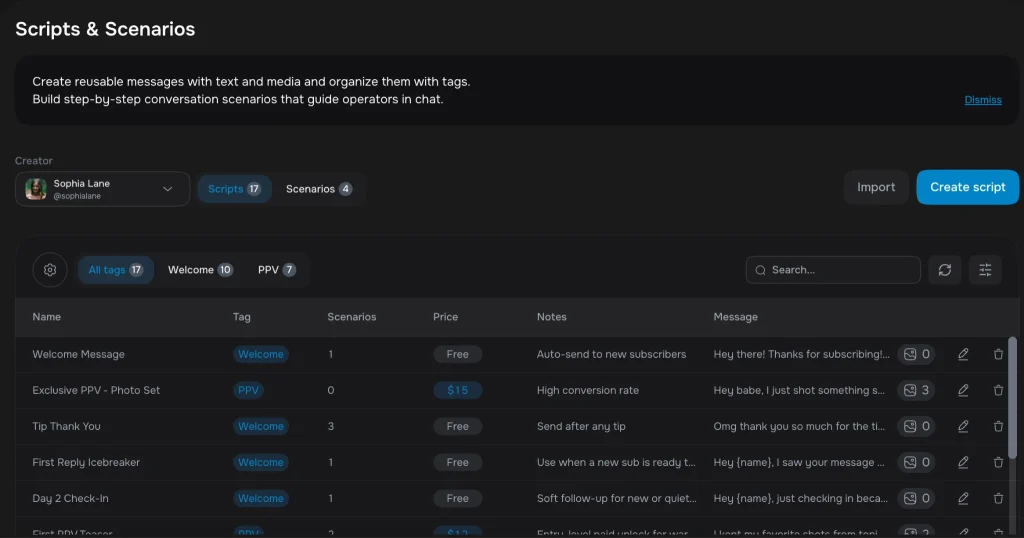
Scripts are saved message templates. Your best-performing lines, greetings, and offers live in a library, ready to send with one click. A strong tool supports personalization tags, so a script that says “Hey {name}” fills in each fan’s name automatically. You can attach media and set a PPV price right on the script. Your team sends proven messages in seconds instead of writing from scratch every time.
This does two things for sales. First, it protects quality. New chatters send the same high-converting message your top seller wrote, so your worst chat is never terrible. Second, it protects speed. Fast replies close sales, and top operations aim for a response time under two minutes. Templates make that possible even at busy hours.
Flows take it further. A flow chains several scripts into a guided sales sequence: a greeting, a warm-up, an offer, then an upsell. Some tools add conditional branches, so the next message changes based on how the fan replies. If the fan says “yes,” they go down one path. If they say “maybe later,” they go down another. Your chatter is never stuck wondering what to send next during a live sale. The system walks them through a funnel that already works.
Mass messages that do not spam your best fans
Sometimes you want to reach many fans at once. A new content drop, a weekend promo, a re-engagement blast. Sending that by hand is slow and risky. A CRM turns it into a targeted campaign.
The power is in the targeting. Instead of blasting everyone, you build an audience with include and exclude rules. You can filter by total spend, by how much a fan has tipped, by how long they have been subscribed, or by whether they are online right now. So you can build a list like “fans who spent over 50 dollars and are online” and send them a premium offer, while excluding a “do not disturb” list and anyone your team is already chatting with live.
That last part is key. A blind mass message can interrupt a chatter who is mid-sale with a big spender. Good campaign tools let you exclude recent chats, so your automated blast never steps on a live conversation.
After the send, you do not guess. The campaign report shows how many messages were delivered, how many fans unlocked the PPV, the conversion rate, and the exact earnings. You learn which offer and which price worked, then repeat the winners. This is how a well-run team gets 30 to 60 percent of new subscribers to make their first PPV purchase within seven days.
Automation that sells while your team sleeps
Your fans do not all buy at the same hour. Someone subscribes at 3 a.m. in another time zone, gets no reply, and cools off by morning. That is a lost sale you never even saw. Automation closes that gap.
A CRM lets you set messages that fire on an event instead of by hand. A welcome message goes out the second a new fan subscribes, while they are still excited and most likely to buy. This matters because speed drives the first sale, and the goal is to turn a fresh subscriber into a first PPV purchase within days, not weeks. A warm welcome with a small, tempting offer starts that clock right away.
The same logic works at the other end. A win-back message can target fans whose subscription recently expired, pulling some of them back before they forget you exist. A gentle nudge to fans who went quiet can revive a chat that was about to die. None of this needs a human sitting at the keyboard at the perfect moment. You set the rule once, and it works every day.
Automation does not replace your chatters. It hands them warmer conversations. The fan gets a fast, relevant first touch from the system, then a real person steps in to build the relationship and close the bigger sales. You get the best of both: the speed of software and the warmth of a human.
Metrics that show where your money leaks
You cannot fix what you cannot see. The biggest sales gains often come from spotting a weak step and repairing it. A CRM built for OnlyFans gives you a dashboard for exactly this.
Look at the fan funnel. It tracks fans through four stages: subscribers, contacted, PPV buyers, and repeat buyers. Each stage has a conversion rate. If a lot of subscribers are never contacted, your team has a coverage problem, and you are leaving easy money on the table. If plenty of fans are contacted but few buy, your offers or pricing need work. The funnel tells you which one it is.
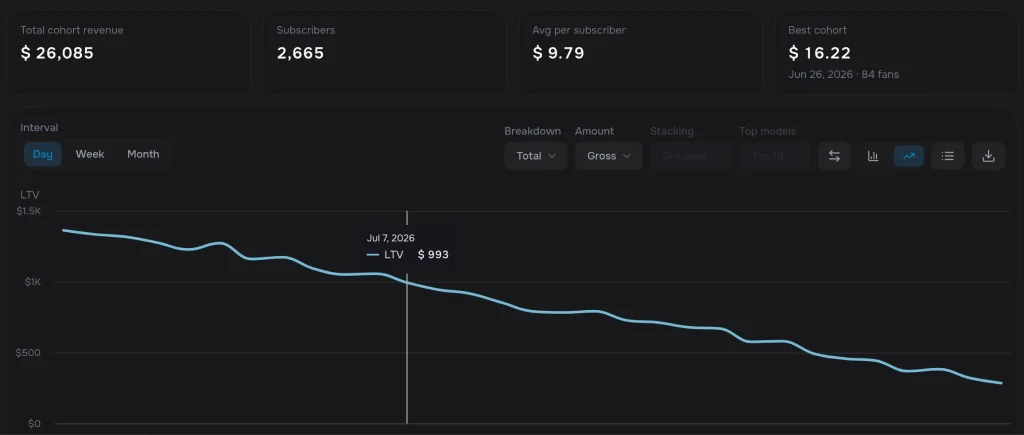
Then there is lifetime value by cohort. This groups fans by when they joined and shows the average revenue each group brings over time. It answers a question most creators cannot: are the fans I am getting this month actually worth more than last month’s? Rising LTV means your funnel is improving. Falling LTV is an early warning you can act on before revenue drops.
This is the kind of visibility a purpose-built platform gives you. It brings balances, revenue, subscriptions, LTV cohorts, and the full fan funnel into one analytics view, with a per-creator and per-chatter breakdown so you can see exactly where a stage drops. When you can point to the leaking step, you stop guessing and start fixing.
Revenue reports round it out. Average check, best-performing periods, gross versus net, and breakdowns by content type all live in one place. You stop exporting screenshots from OnlyFans and start making decisions from clean numbers.
Team accountability that protects your revenue
If you run an agency, your chatters are your sales team. And like any sales team, some close well and some do not. Without per-person data, you cannot tell the difference until the monthly payout looks wrong.
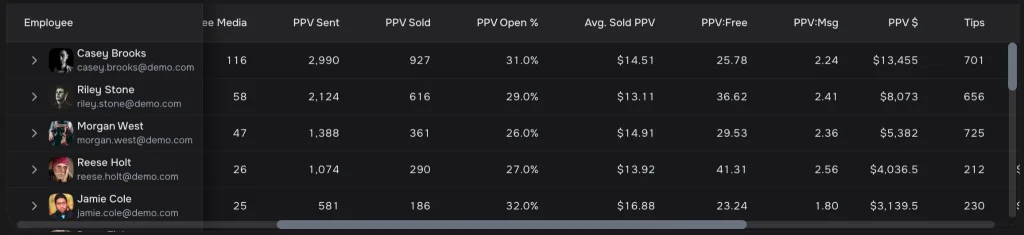
A CRM tracks performance by employee. You can see messages sent, PPVs unlocked, tips collected, and revenue earned per chatter, often exportable to a spreadsheet for payroll or bonuses. Shift and sales tracking ties each sale to the person who made it, even when several chatters work the same account across a day.
This raises sales in two ways. It rewards your best closers, so they stay motivated and you keep them. And it exposes weak spots fast, so you can coach a struggling chatter with real examples instead of vague feedback. A team that knows its numbers are visible simply sells harder.
There is a handover benefit too. Many tools generate an AI summary of a conversation, so the next chatter starting a shift gets a quick recap of what was promised, what the fan wants, and where the sale stands. No dropped threads, no forgotten promises, no fan asking “did you forget about me?”
CRM vs a spreadsheet: a side-by-side look
Plenty of small teams still run on a spreadsheet and memory. Here is how that compares to a purpose-built CRM once volume grows.
| What you need | Spreadsheet and manual work | Purpose-built CRM |
|---|---|---|
| Fan history and spending | Scattered, often outdated, easy to lose | Live profile with spend, notes, and PPV history |
| Fast, on-brand replies | Typed from scratch, quality varies by person | One-click scripts and guided flows |
| Reaching many fans at once | Manual, slow, no real targeting | Filtered campaigns with exclude rules |
| Knowing what works | Guesswork and gut feeling | Fan funnel, LTV cohorts, revenue reports |
| Team performance | Hard to measure, disputes over pay | Per-chatter sales and shift tracking |
The spreadsheet is fine for one small account. Once you have several creators and a team, the manual approach quietly caps your income. The CRM removes that cap.
Your first 30 days with a CRM
You do not need to use every feature on day one. Here is a simple order that gets results fast.
- Connect your creator accounts and import your fan data. Give the tool a few days to sync spending history.
- Build your first fan segments. Start with three: top spenders, active buyers, and inactive fans. These three lists alone change how you sell.
- Load your five best messages as scripts. Add personalization tags and set PPV prices. Have the whole team use them.
- Build one flow for your main sale. A greeting, an offer, and one upsell branch is enough to start.
- Run one targeted campaign. Send a promo to active buyers who are online, exclude your do-not-disturb list, and check the report.
- Open the fan funnel at the end of week two. Find the weakest stage and fix that one thing.
- Review per-chatter numbers at the end of the month. Reward your top closer and coach the rest.
Follow this and you will see the two things that matter most: faster replies and more PPV unlocks. Both feed directly into revenue.
Glossary
- PPV (pay-per-view): locked content a fan pays to unlock inside a message. The main sales engine on OnlyFans.
- Chatter: a team member who talks to fans and sells on a creator’s behalf.
- Fan funnel: the path a fan takes from subscriber to contacted, to buyer, to repeat buyer.
- LTV (lifetime value): the total revenue one fan brings over the whole time they stay.
- Cohort: a group of fans grouped by when they joined, used to compare quality over time.
- Conversion rate: the share of contacted fans, or delivered messages, that turn into a purchase.
- Smart List: a fan list that updates itself based on rules like spend or activity.
- Script: a saved, reusable message template, often with a name tag and a set price.
- Flow: several scripts chained into a step-by-step sales sequence.
A quick example of the numbers
Now the team adds a CRM. Faster replies and better targeting lift the PPV conversion rate. Fan profiles help chatters price offers to each spender. Even a modest 20 percent lift on that 12,000 dollars is 2,400 extra dollars a month, close to 29,000 dollars a year, from the same fan base and the same team. That tracks with the broad CRM benchmark of a 29 percent sales lift, and it is why retention and personalization tools pay for themselves quickly. Your real numbers will vary, but the direction is consistent: better data in the chat means more money out of it.
FAQ
How fast will I see more sales after switching to a CRM?
Most teams feel the change within the first two weeks, mainly from faster replies and reusable scripts. The bigger gains, from funnel fixes and better targeting, show up over the first month or two as you act on the data.
Is using a CRM against OnlyFans rules?
A CRM helps you organize fans, save templates, and read reports. That is standard business practice. Always follow OnlyFans terms of service, keep human chatters in control of conversations, and avoid anything that fakes identity or dodges platform limits.
Do I need a big team to make a CRM worth it?
No. Even a solo creator or a two-person team benefits from fan profiles, saved scripts, and clear reports. The tool saves the most time exactly when you have the least of it.
What is the single feature that increases sales the most?
For most teams, it is the fan profile with spending data. When a chatter knows what a fan can afford and what they like, the right offer at the right price follows, and PPV unlocks go up.
Can a CRM manage several creators at once?
Yes. Purpose-built OnlyFans tools are made for agencies running many accounts. You get per-creator reports, shared scripts, and team tracking across every model in one place.
Is a CRM worth the cost for a growing account?
Think of it in terms of one extra sale. If the tool helps your team unlock a few more PPVs a day, it usually pays for itself long before the month ends. The real return comes from retention, since keeping a paying fan is far cheaper than finding a new one, and a CRM is built to keep them.
Ready to turn your chats into predictable sales? A CRM built for OnlyFans agencies gives your team the fan data, scripts, and reports they need to sell more without working more hours