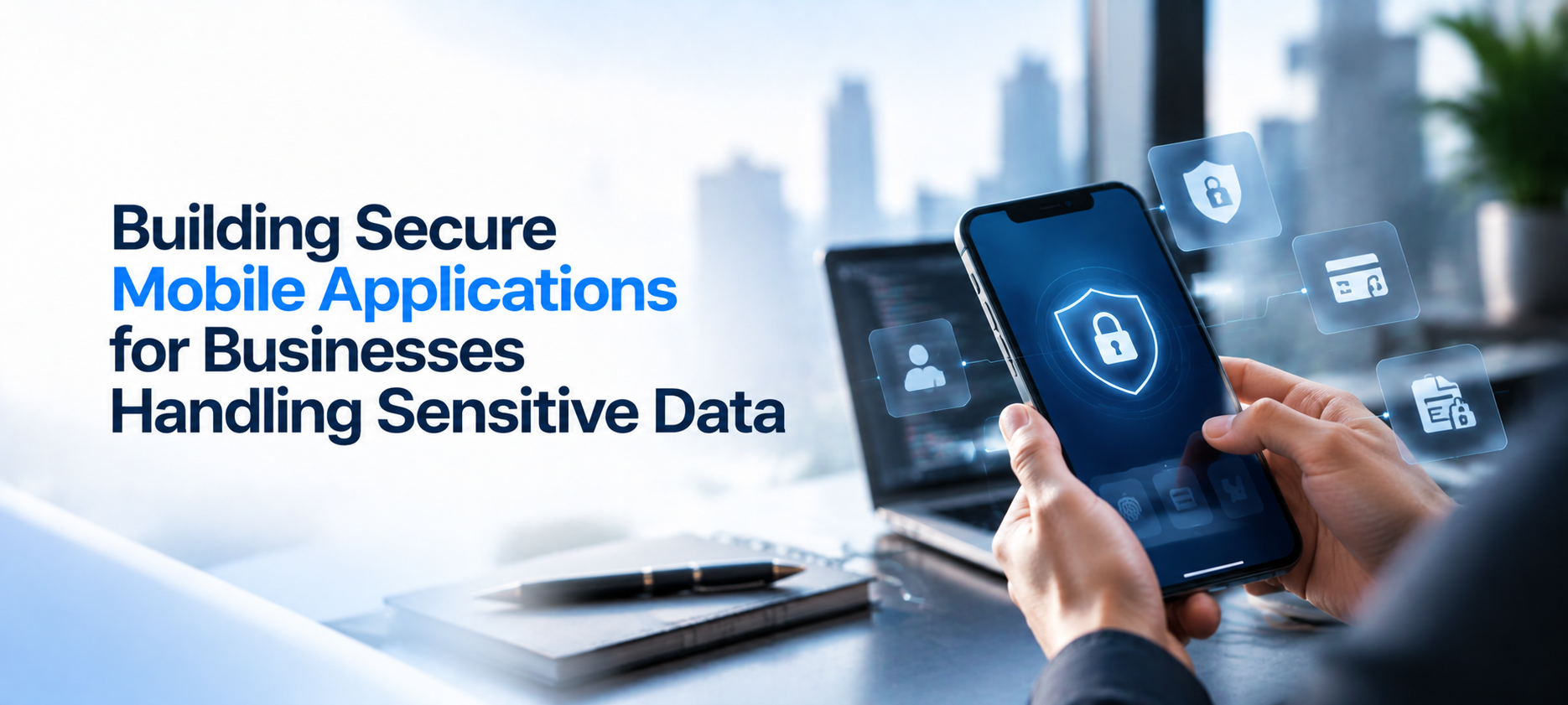
Building Secure Mobile Applications for Businesses Handling Sensitive Data
Every business that collects customer records, payment details, health information, or financial data eventually faces the same question: can its technology keep pace with growth without putting that data at risk?
For many organizations, the answer arrives too late. A mobile app built quickly to meet an early market need begins to strain under more users, more integrations, and stricter compliance expectations. Security fixes get layered onto code that was never designed for them, and every new feature adds another possible point of exposure.
This is why decision-makers increasingly treat mobile applications as long-term infrastructure rather than one-time projects. Investing in custom mobile app development services built around security from day one gives a business room to scale without rebuilding its foundation every few years.
The Hidden Cost of Weak Architecture
Growth bottlenecks rarely begin with one dramatic failure. They appear as slower release cycles, rising cloud bills, audit findings that take months to resolve, and developers who hesitate to touch fragile code. When sensitive data runs through that system, each of those problems carries legal and reputational risk on top of the operational cost.
What Defines an Enterprise-Grade Secure Application
When sensitive data is involved, “enterprise-grade” is a practical standard, not a marketing label. The mobile app is usually only the front door, which is why many organizations pair it with custom software development services that connect the app securely to back-end systems, analytics, and automation tools.
Five qualities separate enterprise-grade applications from the rest:
Scalability. The app handles ten times the users or transactions without a rewrite, and security controls scale along with it.
Security. Encryption in transit and at rest, strong authentication, role-based access, and secure storage on the device are built into the design, not bolted on later.
Performance. Security measures should not make the app feel slow. Well-designed systems protect data without frustrating the people using them.
Reliability. Clear backup, recovery, and monitoring processes mean outages are brief and data is never lost.
Integration capabilities. Secure APIs let the app connect with CRMs, payment gateways, EHR platforms, or ERP systems without exposing data along the way.
Key Pillars for Long-Term Growth
Modular Architecture: Microservices vs. Monolith
A monolith keeps everything in one codebase. It is simpler to start with but harder to secure and scale as it grows. Microservices split the system into smaller, independent parts, so a sensitive function like payments can be isolated, audited, and protected on its own. For most growing businesses, a well-structured modular approach offers the best balance.
Cloud-Native Development
Cloud platforms offer built-in tools for identity management, encryption keys, logging, and compliance frameworks such as HIPAA, SOC 2, and PCI DSS. Building cloud-native from the start lets a business inherit these protections rather than recreate them.
Data-Driven Decision Making
Secure apps still need to produce useful insights. The goal is to collect only the data you truly need, anonymize it where possible, and make it available for reporting through controlled channels.
Automation and AI Readiness
AI features depend on clean, well-governed data. Apps designed with clear data pipelines and access rules today can adopt fraud detection, predictive analytics, or intelligent assistants later without creating new security gaps.
Common Mistakes Businesses Make
A short-term development mindset. Choosing the fastest, cheapest build often means rebuilding within two years, usually after a security scare forces the issue.
Ignoring scalability early. Security that works for 500 users can break at 50,000. Session handling, rate limiting, and database access need to be planned for future load.
Choosing the wrong tech stack. Popular frameworks are not always the right fit. Poorly maintained libraries or tools with weak security track records create long-term risk that is expensive to undo.
Best Practices for Building Future-Ready Applications
Strategic Planning Before Development
Start with a data map. Know what sensitive information the app will touch, where it will be stored, who can access it, and which regulations apply. Threat modeling at this stage costs far less than fixing vulnerabilities after launch.
Choosing the Right Development Partner
Look for a team that asks about compliance, data flows, and growth plans before discussing features. Firms such as NewAgeSysIT, a custom software and mobile app development company headquartered in New Jersey, approach projects this way. The NJ-based team works primarily with businesses across the United States, helping organizations in regulated and data-sensitive industries build applications designed to scale securely. That kind of early, architecture-first consultation often shapes the success of a project more than any single feature.
Continuous Optimization and Iteration
Security is never finished. Regular penetration testing, dependency updates, performance reviews, and user feedback cycles keep an application strong as threats and business needs evolve.
Real-World Example: Architecture That Enabled Growth
Consider a mid-sized healthcare services provider whose patient app began as a single, tightly coupled system. As appointment volume grew, updates slowed, and every compliance audit required weeks of manual review.
By moving to a modular, cloud-native architecture, the organization separated patient records, scheduling, and billing into independently secured services. Access logs became automated, audits shortened dramatically, and new features shipped in weeks instead of months. Most importantly, the business could expand into new states without redesigning its data protections for each one.
Conclusion
For businesses handling sensitive data, a mobile app is both a growth engine and a responsibility. Applications built on scalable, secure architecture reduce long-term costs, simplify compliance, and give leaders the confidence to expand without fear of what might break next.
The smartest investment is not the fastest build. It is the one designed to protect your data and support your business for years to come. Taking time to plan carefully and consult experienced architects early is what turns a mobile app from a liability into a lasting competitive advantage.