8 Chicken Shawarma Tips for Juicy Meat and Crispy Edges
Chicken shawarma is packed with bold spices, tender meat, and deliciously crispy edges that make every bite irresistible. But getting that perfect balance of juicy chicken and golden-brown edges at home can be tricky. The secret lies in the marinade, the way you prepare the chicken, and how you cook it. These 8 chicken shawarma tips will help you bring authentic Middle Eastern-inspired flavor to your kitchen.
How to Cook Chicken Shawarma
Use Chicken Thighs for the Perfect Shawarma
The key to achieving the perfect shawarma is to use chicken thighs. Thighs contain more fat than breasts which helps retain juiciness while developing the dark, caramelized edges. Also, having all of your pieces roughly the same size (or as close to it as possible) will help ensure that all of the pieces are finished at the same time.
Give Your Marinade Time to Work
Give your marinade time to work. As mentioned earlier, marinades are essential for creating the flavor profile of traditional shawarma. However, allowing your marinade to sit on the chicken for an extended period of time does not guarantee success.
Marinating your chicken should be treated like a timed event. The longer you marinate your chicken, the deeper your flavors will penetrate into the meat. Additionally, the marinade is the primary source of flavor on the outside of the chicken once you begin cooking.
Therefore, you need to apply a sufficient amount of marinade, but not so much that it interferes with browning. If your chicken goes into the pan or onto the grill with too much marinade on it, most of the heat being applied will go towards evaporating that moisture, thereby preventing the development of the dark exterior you are trying to achieve. Remove excess marinade prior to cooking, and allow the pieces to breathe a little bit as well. A crowded cooking surface retains moisture and reduces the ability to obtain the desired browning.
Use High Heat Strategically
To accomplish the desired browning of your chicken, use high heat strategically. The ultimate goal is not to cook your chicken at max heat for max length of time. Max heat is excellent for obtaining color, however, it can also quickly overcook the outside of your chicken before thicker pieces reach an acceptable level of doneness.
To prevent this, cook your chicken under controlled heat until it is mostly done and then finish it off with a burst of max heat to produce additional caramelization. This technique is especially efficient when using a broiler. Cook your chicken just shy of doneness and then hit it with a quick burst of heat. This way you don’t have to subject the entire piece to extreme heat for an extended period of time.
Do Not Judge Doneness Solely Based Upon Caramelized Edges
Crisp-edged chicken can be deceiving. While the caramelized edges appear appealing and inviting, they are merely indicative of what is occurring on the surface. The interior condition of your chicken cannot be determined based solely upon appearance. On the other hand, if you cook your chicken long enough to develop significant amounts of browning on the exterior, it doesn’t automatically mean that it was fully cooked internally.
Appearance and internal doneness are two completely different measures. While appearance should guide you in determining if there is adequate browning present on your chicken, internal temperature should guide you in determining if the chicken is cooked to a safe minimum internal temperature.
Check Internal Temperature Fast
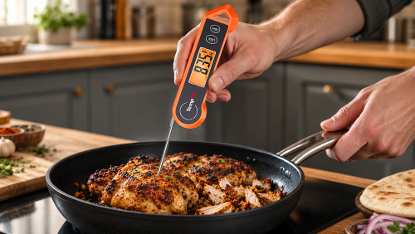
Because your chicken can be subjected to extreme temperatures in order to develop those signature crisp-edged browned exteriors, it’s critical that you measure internal temperature as quickly as possible. The TempPro TempSwift PLUS TP19H Instant-Read Meat Thermometer utilizes an ultra-rapid thermocouple sensor to give you accurate internal temperature readings in 1 second response time. Unlike placing your hand near a hot grill or pan while waiting for a thermometer to stabilize, you can place the tip of the thermometer in the thickest part of the chicken and receive a rapid accurate reading quickly.
This rapid temperature reading is especially beneficial when nearing completion of cooking. Because you’re attempting to produce those attractive browned edges, any additional minute or two at full intensity heat could result in loss of juices in your chicken. In addition to providing fast temperature readings, the TempSwift PLUS TP19H offers a bright-backlit LCD display that features 180° automatic rotation, making it easy to view readings from various angles when working around a grill or under a broiler or when accessing pieces from unusual positions.
Check Multiple Pieces of Chicken
Instead of relying on one piece of chicken as representative of all others, use multiple pieces as indicators of readiness. Even when pieces resemble each other closely in terms of size and visual presentation, they typically cook at slightly varying rates. Each piece may differ slightly in thickness; one may have been placed closer to a hotter section of the grill; another may have been cooler due to its position; etc. Thus, evaluating multiple pieces provides significantly greater insight into overall readiness than evaluating one piece and assuming that all pieces are finished.
The speed provided by the TempPro TempSwift PLUS TP19H Instant-Read Meat Thermometer allows you to rapidly evaluate numerous pieces with minimal interruptions.
Rest Your Chicken Before Slicing
Once your chicken is removed from heat, let it rest for a few minutes before slicing. Slice your rested chicken into the thin strips typical of shawarma. For added crispy edges, briefly reheat those slices in either a hot skillet or directly under the broiler. Reheating allows you to add more surface area to further develop browning without having to run an entire new cooking cycle on the larger pieces.
Make Cleanup Simple
Cleanup after using the TempPro TempSwift PLUS TP19H Instant-Read Meat Thermometer Digital is also quite easy. It is IP65 rated waterproof so cleaning can take place under running water.
FAQs about Cooking Chicken Shawarma
Why does my homemade chicken shawarma turn out dry?
Overcooking is one of the most common causes. Chasing additional browning after the chicken has already reached doneness can quickly remove moisture, particularly when using high heat.
Should I use chicken thighs or chicken breast for shawarma?
Both can work, but chicken thighs are generally more forgiving because their higher fat content helps them remain juicy during high-temperature cooking.
Why isn’t my shawarma developing crispy edges?
Excess marinade, overcrowding and insufficient surface heat can prevent browning. Remove excessive marinade and give the chicken enough room for moisture to escape.
Why use an instant-read thermometer for chicken shawarma?
An instant-read kitchen thermometer allows you to determine internal doneness separately from exterior browning. The TempPro TempSwift provides readings in approximately 1 second response time, making it particularly useful when cooking chicken over high heat.
Can the TempPro TempSwift PLUS TP19H be washed after handling chicken?
Yes. The TempPro TempSwift PLUS TP19H features an IP65-rated waterproof design and can be cleaned under running water after use.
Conclusion
In summary, great homemade shawarma is achieved by managing two independent elements, internal doneness and external browning.
Prepare and marinate your chicken adequately, and utilize strategic heat application methods to realize both aspects of shawarma together.
Additionally, do not confuse internal doneness with browned edges. Measure internal temperature with precision using an instant-read meat thermometer, like the TempPro TempSwift PLUS TP19H, and visually assess browning separately.