Choosing the First Part for a Cobot Welding Cell
The part with the longest weld is not always the best place to begin automation. It may take too long to load, arrive with inconsistent geometry, or need access that a robot cannot achieve without an elaborate fixture. A modest bracket made every week can be a more useful starting point than a large assembly that rarely repeats.
Before selecting a cobot welder, a shop needs to choose a job that gives the system a fair chance to earn its place. That choice depends on repeat demand, part presentation, joint access, and the time spent around the weld. A manageable first application makes the production result easier to understand.
Recurring Production Demand
A familiar part number is not proof of a repeatable workload. Orders may arrive once a year, the design may change frequently, or every batch may require a different material. Recent production records give a better picture than a catalogue of everything the shop has ever made.
Recurring brackets, enclosure components, or similar assemblies can be candidates when their joints and dimensions remain consistent. The relevant volume is the quantity that will use the same setup, not the total number of welds performed elsewhere in the business.
Repeat work also gives the team opportunities to refine loading and inspection. A first application that disappears for six months makes that learning harder to sustain.
Joint Access and Part Presentation
A robot must reach the seam with the welding head in a suitable position. That includes the approach, the weld, and the departure. Fixtures, clamps, neighboring features, and the cable route can all restrict movement even when the seam looks accessible on a drawing.
For laser welding, beam position and joint fit-up are particularly important. A fixture has to locate the parts and hold them stable without obstructing the joint. Excessive variation in incoming parts can turn a promising application into repeated adjustment work.
Seam tracking may help with certain positional variations, but it does not remove the need for sound fixtures or correct large gaps. DenaliWeld lists seam tracking as an option on its cobot system, so its suitability belongs in the application review rather than being assumed.
Loading and Inspection Time
Welding may occupy only a small portion of the present cycle. If the operator spends most of the time aligning loose pieces or repositioning a large assembly, automating the seam alone may leave the bottleneck untouched.
A candidate part should be assessed from loading to removal, with inspection included. The operator still needs a workable routine for preparing parts, checking the first piece, and responding when an incoming component does not fit. Automation changes the task; it does not eliminate those responsibilities.
Comparing Candidate Parts
A simple comparison helps avoid choosing the part that happens to attract the most attention. Each candidate needs evidence from current production and a trial of the proposed welding arrangement.
| Selection factor | Promising first application | Reason to investigate further |
| Order pattern | Regular demand for the same setup | Rare orders or frequent design changes |
| Joint access | Clear head access through the full path | Clamps or features obstruct the seam |
| Part location | Repeatable loading into a suitable fixture | Variable gaps or unstable positioning |
| Handling | Straightforward loading and unloading | Alignment dominates the cycle |
| Quality checks | Defined and practical acceptance criteria | Requirements not yet agreed |
A Representative Batch Trial
The first trial should include normal incoming variation and repeated loading, not just a single assembly prepared by the integration team. Record accepted parts, cycle time, loading difficulties, interruptions, and rework. These observations show whether the fixture and process are ready to support routine production.
The risk assessment covers the completed application, including the robot, welding process, fixture, and operator tasks. A collaborative arm does not make an open laser welding area safe. Beam containment, controlled access, and the relevant protective measures remain necessary.
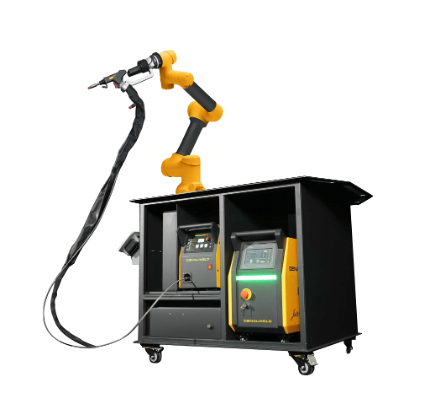
DenaliWeld publishes cobot systems compatible with its air-cooled and water-cooled laser platforms. That provides a starting point for an equipment discussion, while the proposed part determines the fixture, head access, options, and validation work the project needs.
What the First Job Establishes
A successful first application leaves more than a running robot program. It leaves a reliable loading method, approved welding settings, clear acceptance criteria, and operators who know when the job is outside its normal conditions.
The best opening project is often a recurring part with a controllable setup and a measurable production problem. Once that job is working consistently, the shop has a sound basis for deciding which part should come next.
Conclusion
The first cobot welding job should be straightforward enough to validate and regular enough to remain useful. Repeat demand, stable part location, accessible joints, and practical quality checks give the project a stronger starting point. A successful pilot then provides the working method and production evidence needed to assess further applications.