
The Hidden Gaps in Sanctions Screening That Create Compliance Risk
A customer goes through sanctions and watchlist screening software during onboarding. No match appears, so the application moves forward.
The result may be accurate, while political exposure, criminal history, adverse media, or emerging risks remain unseen.
Sanctions screening provides an essential baseline within a broader assessment.
But truly effective compliance relies on a continuously updated view of the customer across multiple risk signals.
Sanctions screening is essential, but it answers only one question
Sanctions screening asks one direct question: Does this person or entity appear on a designated list?
That answer is critical. Businesses must identify parties subject to asset freezes, transaction bans, or other restrictions.
However, sanctions lists cover formally designated people, companies, and organizations. They do not show every relevant fact about a customer.
Namely, they may miss:
- political exposure
- criminal history
- concerning relationships
- emerging lifestyle-related risk
The limitation is not sanctions screening itself. But treating a clean result as a complete assessment can jeopardize the outcome and affect the institution.
That’s why one dataset cannot provide the full customer risk picture.
The most important warning signs often sit outside sanctions lists
Risk does not always appear during the first screening. It may emerge weeks or months after onboarding.
A customer can pass every initial sanctions check. Later, credible reporting may connect them to a fraud investigation. A company director may also take a politically exposed role.
This timing gap creates difficult decisions for risk teams. The original assessment may have been correct, but it no longer reflects the customer’s current profile.
Without updated context, the business may:
- Understate risk. The customer keeps an outdated risk rating.
- Miss escalation. New concerns never reach the right reviewer.
- Delay action. Teams discover the issue during an audit.
- Apply weak controls. Enhanced due diligence starts too late.
The main concern is the business impact of acting on an incomplete customer profile.
A stronger customer view comes from combining distinct signals
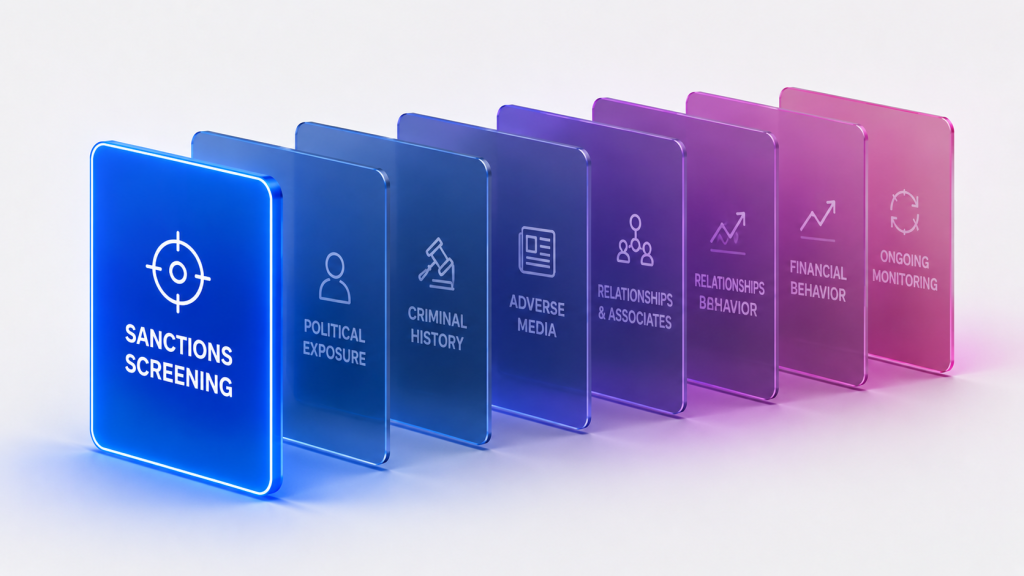
Comprehensive screening works best as a layered process. Each layer answers a separate risk question.
Together, those answers create a clearer assessment and help teams explain why a certain decision was made.
PEP screening
PEP screening identifies people with prominent public functions. It also covers relevant family members and close associates.
PEP status does not suggest wrongdoing. It highlights possible exposure to public funds, political influence, or conflicts of interest that may justify closer review.
Criminal-record screening
Criminal-record screening can reveal convictions or legal histories linked to financial misconduct, organized crime, or other relevant offenses.
Teams should assess each result in context. Relevance, severity, timing, and local legal requirements should shape the response.
Adverse-media screening
Adverse-media screening surfaces credible reporting about investigations, allegations, regulatory concerns, or reputational issues.
It can reveal developing risk before formal action occurs. Source quality, evidence, recency, and context determine how much weight a result deserves.
Ongoing monitoring
Customer risk can change after onboarding. Political roles shift, investigations begin, and new relationships or reports emerge.
Regular re-screening helps teams detect material changes. We have seen strong onboarding decisions lose relevance because the customer’s circumstances changed.
No single signal should make every decision. The value comes from seeing the signals together.
More data only helps when businesses use it proportionately
Broader screening does not justify collecting unlimited personal information. Businesses need relevant and lawful data for defined compliance purposes.
The goal is not to know everything about someone. It is to find information that materially affects risk.
Screening should support a documented, risk-based process. It should never create automatic guilt through association.
A PEP match or negative article requires proper validation. Criminal-record results also need context and human review.
False positives remain common with similar names and spellings. Common names can generate several unrelated matches.
Outdated reporting may also create a misleading impression. Clear audit trails help teams record how they resolved these issues.
AI can reduce screening friction, but people still own the decision
Modern AML screening software can combine sanctions, PEP, criminal-record, and adverse-media checks within one review process.
AI can compare names across different spellings and languages. It can also prioritize likely matches for investigation.
Systems can group related media reports and recurring entities. They can identify relationships that may otherwise remain scattered.
AI can also flag changes that require re-screening. Better filtering may reduce large volumes of irrelevant alerts.
This support matters because compliance teams face constant regulatory pressure. They must review cases carefully while avoiding unnecessary delays.
Still, AI should organize evidence rather than replace accountability. People must remain responsible for the final risk decision.
Teams need governance, review controls, and traceable reasoning. An unexplained automated decision creates a new compliance risk.
Better context leads to fewer blind spots and fewer unnecessary delays
A richer customer view helps teams direct attention where it matters. Higher-risk cases can receive enhanced due diligence sooner.
Better context can also protect legitimate customers. Weak matching often sends low-risk applicants into repeated manual reviews.
In our experience, better signals improve both control and efficiency. Teams spend less time resolving alerts with little relevance.
The benefit is not simply more screening. It is better-targeted and more consistent scrutiny.
Compliance depends on context, not one clean result
Return to the original onboarding case. The customer passed the sanctions check, but other risks remained unseen.
That does not make sanctions screening less important, but the surrounding process should stand out too.
Businesses do not build trust by collecting the most data. They build it by noticing the right signals, interpreting them carefully, and continuing to pay attention after onboarding.