Startup Logistics: Why Your Delivery Business Needs a Cargo Electric Dirt Bike Instead of a Van
For decades, logistics startups have made the same assumption:
If you’re serious about delivery, you need a van.
It sounds logical. Vans carry more. Vans look professional. Vans are what established companies use.
But in 2026, that assumption is quietly killing margins.
In dense cities, high-frequency delivery businesses are discovering an uncomfortable truth: the van is often the least efficient tool for the job. It is overbuilt, overpriced, and poorly matched to the realities of modern urban logistics.
A new category is stepping in to fill that gap—cargo-capable electric dirt bikes, designed not for trails, but for speed, flexibility, and all-day operation inside cities.
The “Van Trap” for Early-Stage Delivery Businesses
Most delivery startups fall into the same trap early on.
They raise a small amount of capital, lease or purchase one or two vans, brand them, insure them, and assume they are ready to scale. What follows is a slow bleed of cash. Vans come with structural costs that don’t scale well:
- High upfront capital expenditure.
- Insurance premiums that rise with every claim.
- Fuel costs that fluctuate unpredictably.
- Parking tickets, congestion charges, tolls.
- Idle time stuck in traffic.
For “last-mile” or small-batch, high-frequency delivery, the van is usually overkill. It carries far more capacity than is used, while moving far slower than required.
In most urban delivery routes, the limiting factor isn’t load volume. It’s time.
Agility Is the New Efficiency Metric
In logistics, speed is not about top speed—it’s about average speed per hour of operation. Two-wheel vehicles consistently outperform four-wheel vehicles in cities because they:
- Bypass traffic congestion.
- Access alleys and narrow service roads.
- Park directly at pickup and drop-off points.
- Eliminate walking distance from curb to door.
This is where a rugged electric dirt bike becomes a logistics asset rather than a recreational vehicle.
Unlike fragile city e-bikes, a dirt-bike-style platform can handle broken pavement, potholes, curb cuts, and poor weather conditions. For startups optimizing delivery time per order, this agility directly translates into higher order throughput per rider.
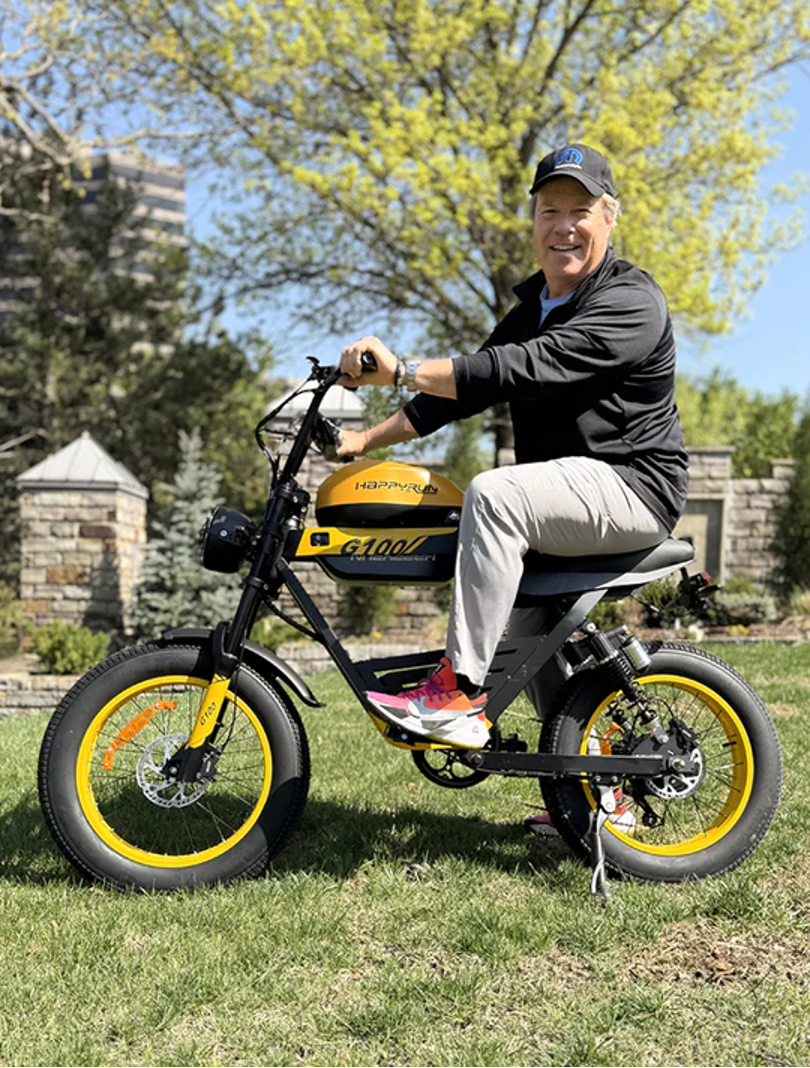
The Workhorse Model: Why the HappyRun G100 Fits Logistics Use
A delivery vehicle is only as good as its weakest constraint. For electric platforms, that constraint is almost always range.
This is where the HappyRun G100 stands out as a logistics-focused tool rather than a lifestyle toy.
The G100’s 48V 38Ah dual battery system is not a marketing detail—it is the core reason it works for business use. In real-world delivery operations, this configuration means:
- A full 8–10 hour shift without mid-day charging.
- No forced downtime between peak lunch and dinner windows.
- Predictable routing without battery anxiety.
- Fewer backup vehicles needed per rider.
In logistics, downtime equals lost revenue. A vehicle that must stop to charge halfway through a shift is not commercially viable.
With a 2000W motor, the G100 also maintains consistent acceleration and hill-climbing capability even when carrying cargo—something underpowered city e-bikes struggle with once loaded. Its extended seat and sturdy frame make it suitable for rear cargo boxes, insulated food carriers, or modular delivery racks, transforming the bike from personal transport into a mobile delivery platform.
The Economics: Van vs Electric Bike ROI
Let’s simplify the numbers.
A typical urban delivery van:
- Purchase or lease cost: $30,000+
- Monthly fuel: hundreds of dollars
- Insurance: high
- Maintenance: frequent and expensive
- Parking and fines: ongoing risk
A cargo-capable electric bike (like the G100):
- Fraction of the purchase cost
- Electricity costs measured in cents, not dollars
- Minimal maintenance (no oil, no transmission)
- No parking fees
- No congestion charges in most cities
When startups search for an electric motorcycle for sale specifically for delivery use, what they are really calculating is return on investment.
In many real-world cases, a bike like the G100 can:
- Pay for itself in 1–2 months of daily operation.
- Reduce per-order delivery cost immediately.
- Allow one rider to complete more orders per hour than a van.
- Scale fleets incrementally instead of in large capital jumps.
This is not about replacing vans entirely—it’s about using the right tool for the right delivery tier.
Real-World Logistics Use Cases
Cargo electric dirt bikes are already being used successfully for:
- Legal and corporate document courier services.
- Pharmacy and medical sample delivery.
- Restaurant supply restocking.
- Small auto parts and electronics distribution.
- Local B2B service calls.
In each case, speed, access, and uptime matter more than payload size. The result is a leaner logistics model that prioritizes velocity over volume.
Leaner, Faster, Smarter: The Future of Startup Logistics
The future of logistics is not one-size-fits-all.
Vans will still exist—but they will no longer be the default starting point. For early-stage delivery businesses, flexibility matters more than capacity, and uptime matters more than image.
A cargo electric dirt bike like the HappyRun G100 offers startups lower financial risk, faster deployment, and higher utilization per asset. For founders willing to rethink old assumptions, the advantage is clear.
Logistics isn’t about having the biggest vehicle on the road. It’s about getting the job done faster, cheaper, and more reliably. And in modern cities, two wheels often beat four.